
Quick answer
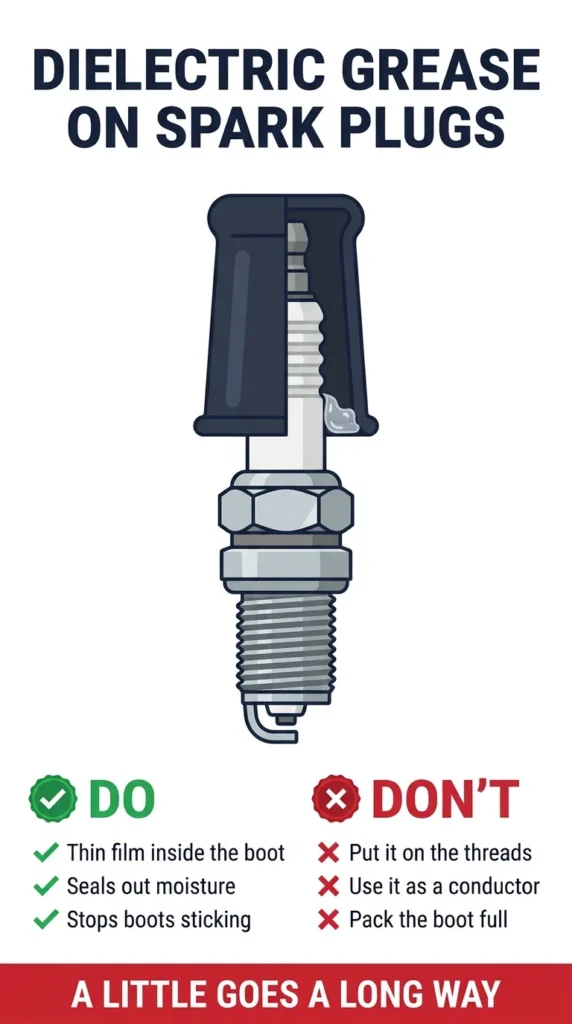
Yes, you can put dielectric grease on spark plugs, but only a thin film on the inside of the rubber boot, where the boot seals against the plug’s white ceramic insulator. It keeps moisture out and stops the boot from sticking to the plug, so it comes off easily next time. Don’t put it on the plug threads, don’t use it as a “conductor” (it isn’t one), and don’t pack the boot full. Spark plugs work fine without it; it’s cheap insurance, not a requirement.
In this guide
Dielectric grease comes up in almost every spark plug job: some people swear by it, others say it causes misfires. Both camps have a point. Used the right way, in the right spot and in a small amount, it helps. Used the wrong way, it can cause problems. This guide shows where it goes, where it doesn’t, and which tube to buy.
What dielectric grease is (and isn’t)
Dielectric grease is a silicone grease, usually silicone oil thickened with a silica filler. Its job is to seal. It repels water, doesn’t harden or wash out easily, and is safe on rubber and plastic. “Dielectric” means it does not conduct electricity. That is exactly why it works as a seal around an electrical connection, and also why it should never be used to “improve” a connection.
| What it does | What it doesn’t do |
|---|---|
| Seals the boot against moisture, dirt and road salt | Conduct electricity or make a better electrical contact |
| Stops the rubber boot from bonding to the ceramic over time | Lubricate or protect the spark plug threads |
| Helps the boot slide on and come off without tearing | Fix a cracked boot or a failing ignition coil |
| Helps reduce arcing along a wet or dirty boot | Replace the correct spark plug torque |
Should you put dielectric grease on spark plugs?
You don’t have to. Spark plugs and ignition coils work fine without it, and many new cars leave the factory with only a trace inside the boots. It is worth using when:
- you live where it’s wet, humid or salty, or you wash the engine bay;
- the boots were hard to pull off last time (they had started to bond to the plug);
- you’re installing new coils or plug wires and want them easy to remove at the next service.
If your coil or plug maker gives instructions, follow those first. Some new coil boots come pre-coated, and adding more is not needed.
Where it goes: step by step
- Install the plug first, clean and dry, torqued to the spec in your owner’s manual or the plug maker’s chart. No grease on the threads.
- Put a small dab on a clean fingertip or a cotton swab. A pea-sized amount is plenty for several boots.
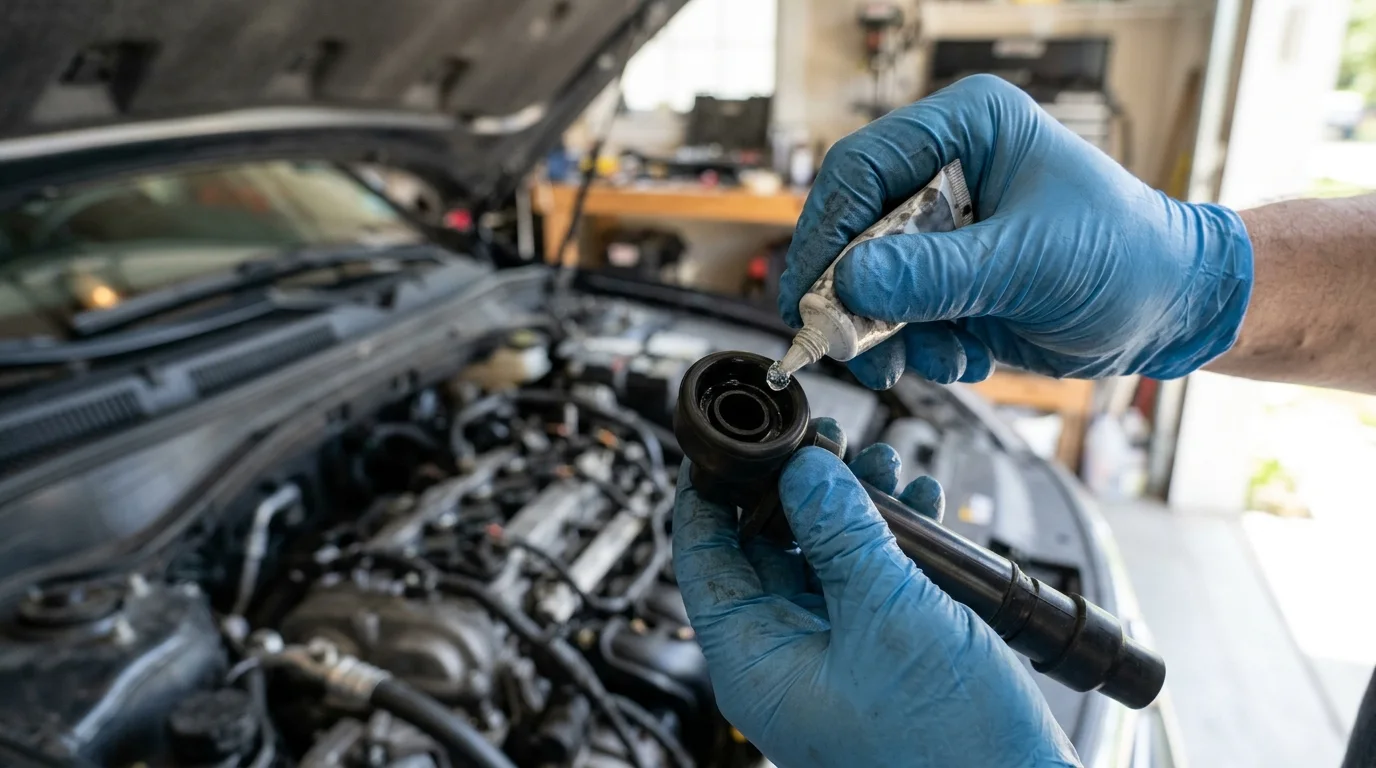
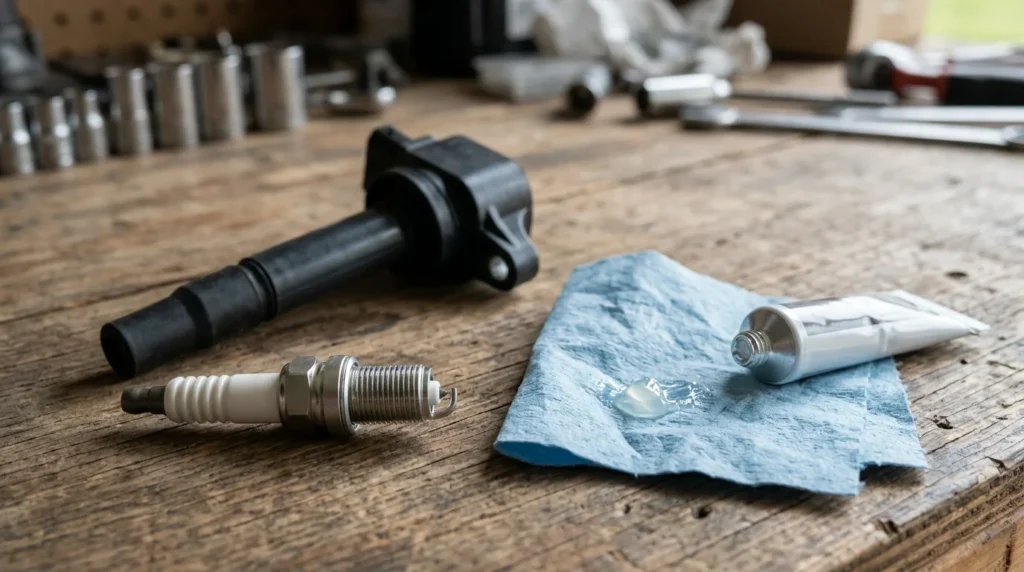
- Spread a thin film around the inside of the boot’s opening, the rubber lip that seals against the white ceramic part of the plug.
- Keep the metal contact clean. The spring or terminal inside the boot needs metal-to-metal contact with the plug tip, so don’t fill the boot or smear grease deep inside it.
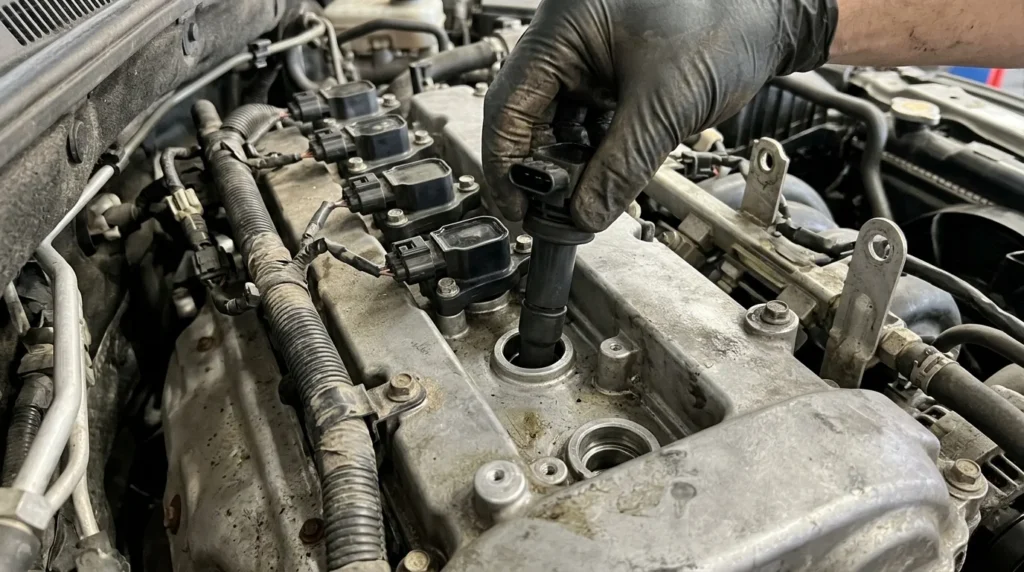
- Push the coil or boot straight down until it seats with a click or stops firmly, then refit any bolts and connectors.
Where it doesn’t go
- Not on the threads. Most modern plugs have plated threads, and plug makers such as NGK say not to use anti-seize or lubricant on them. Lubricant changes how much the plug tightens at a given torque, so it’s easy to over-tighten.
- Not as a conductor. Smearing it on the terminal tip “for a better connection” does the opposite of what you want.
- Not by the handful. A boot packed with grease can trap air and push itself back off the plug, or squeeze grease where it doesn’t belong. As the saying goes, a little goes a long way.
Other good uses on a car
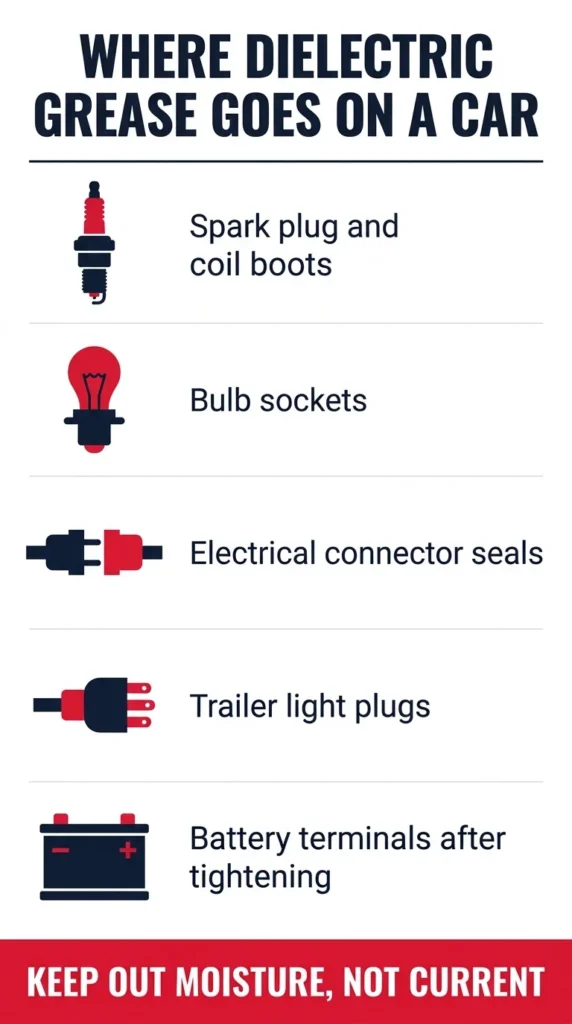
The same tube is useful well beyond spark plugs, anywhere you want to keep moisture away from an electrical connection:
- Bulb sockets for headlights, taillights and turn signals, to prevent corrosion;
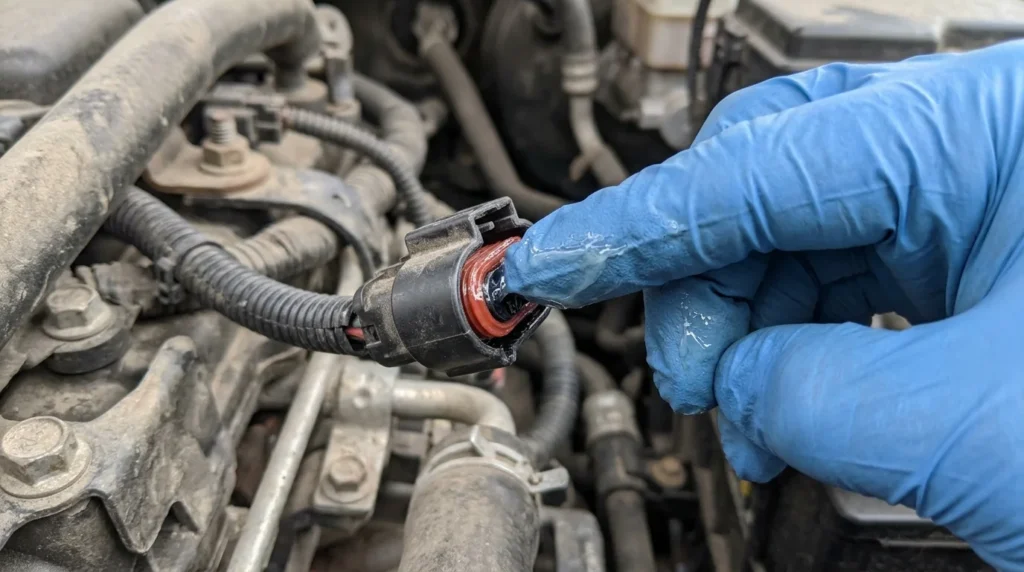
- Weather-sealed connector seals (the rubber gasket, not the pins themselves);
- Trailer light plugs, which corrode quickly from road spray;
- Battery terminals, as a thin coat over the outside after the clamps are tightened, to slow corrosion.
Is dielectric grease the same as silicone grease?
Dielectric grease is a type of silicone grease, sold for electrical use. A general silicone grease will often do the same sealing job on a boot, but tubes labeled “dielectric” or “tune-up” grease are made and tested for ignition and connector use, so they’re the simpler choice. Don’t substitute petroleum-based grease such as white lithium grease on rubber boots; petroleum can swell some rubbers. Our lithium vs silicone grease guide explains why.
Dielectric greases worth considering
How we chose: we looked at Amazon listings on November 28, 2026 and kept only products rated 4.8 stars with at least 1,600 ratings, then picked one tube for occasional use, one larger tub and one brush-top jar. Details come from the makers’ listings. We have not tested these products ourselves. As an Amazon Associate we earn from qualifying purchases.
1. Permatex 81150 Dielectric Tune-Up Grease, 0.33 oz Tube
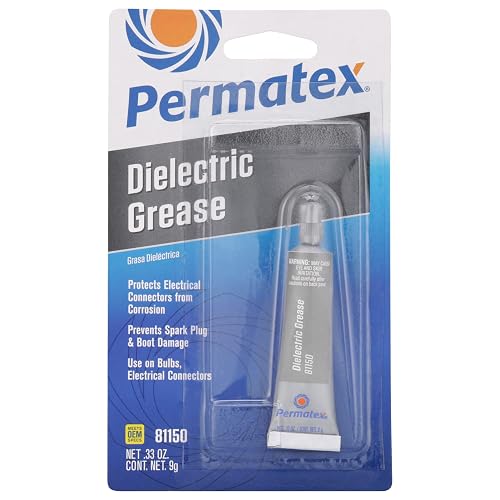
A small tube of dielectric tune-up grease, enough for the boots on a typical spark plug job plus a few bulb sockets.
Why it’s a good pick
- About 29,600 ratings at 4.8 stars (shared with the larger Permatex size)
- Small size, so it doesn’t sit half-used for years
Keep in mind
- Too little for regular connector and trailer-plug use
2. Permatex 22058 Dielectric Tune-Up Grease, 3 oz

A larger tube that the maker lists for protecting terminals, spark plugs, wiring and other electrical connections against salt, dirt and corrosion.
Why it’s a good pick
- About 29,600 ratings at 4.8 stars
- Enough for several cars, bulbs, connectors and trailer plugs
Keep in mind
- More than you need for a single spark plug job
3. AGS Silicone Dielectric Grease, 4 oz Brush Top

A silicone dielectric grease in a jar with a built-in brush, which makes it easier to spread a thin, even film inside boots and around connector seals.
Why it’s a good pick
- About 1,600 ratings at 4.8 stars
- Brush helps you apply a thin layer instead of a blob
Keep in mind
- Fewer ratings than the Permatex tubes
- Wipe the brush before closing so the lid seals
Common questions
Should you put dielectric grease on spark plugs?
It’s optional. A thin film inside the boot keeps out moisture and makes the boot easier to remove later. Skip it on the threads and on the metal terminal contact.
What kills spark plugs quickly?
Common causes include oil or coolant getting into the cylinder, a rich fuel mixture that fouls the tip, the wrong heat range, incorrect gap, and over-tightening that damages the plug. Grease in the wrong place can add to problems, but it is rarely the main cause.
Can dielectric grease cause a misfire?
Used correctly, no. Problems usually come from packing the boot so full that the boot doesn’t seat, or from smearing grease where the metal parts need to touch. If you get a misfire after a plug change, check that every coil is fully seated and every connector is clipped in.
Do I need a torque wrench for spark plugs?
It’s the best way to get the tightness right, especially on aluminum cylinder heads. See our guide on whether you need a torque wrench for spark plugs.
Bottom line
Dielectric grease is a sealant, not a conductor. A thin film inside the spark plug boot keeps water out and makes the next plug change easier. Keep it off the threads and the metal contact, use a small amount, and follow your plug and coil maker’s instructions.
Related guides: Do I need a torque wrench for spark plugs? · Spark plug maintenance tips · Lithium vs silicone grease · What causes an engine misfire?
Sources
- MG Chemicals: Dielectric grease on spark plugs
- AGS Company: Spark plug boot protector dielectric grease
- Wikipedia: Silicone grease
- NGK Spark Plugs installation guidance (no anti-seize or lubricant on plated threads; printed on NGK packaging)
- Product details from each maker’s Amazon listing (checked November 28, 2026); your owner’s manual for spark plug torque