

Quick answer
A torque wrench is the most reliable way to install spark plugs, and it is strongly recommended for aluminum cylinder heads, where an overtightened plug can strip the threads. If you don’t have one, NGK describes a turn method: thread the plug in by hand until it seats, then turn a new gasket-type plug about 1/2 to 2/3 of a turn more, or a tapered-seat plug about 1/16 of a turn. Always check the angle or torque printed on the plug’s box or in your service manual.
In this guide
Spark plugs only need to be tight enough to seal and to transfer heat into the cylinder head. Too loose, and the plug can overheat, leak compression or even back out. Too tight, and you can stretch the plug’s metal shell, crack the insulator or strip the threads in the head. On modern engines with aluminum heads, stripped plug threads mean a thread repair job, so getting the tightness right matters.
Do you really need a torque wrench?
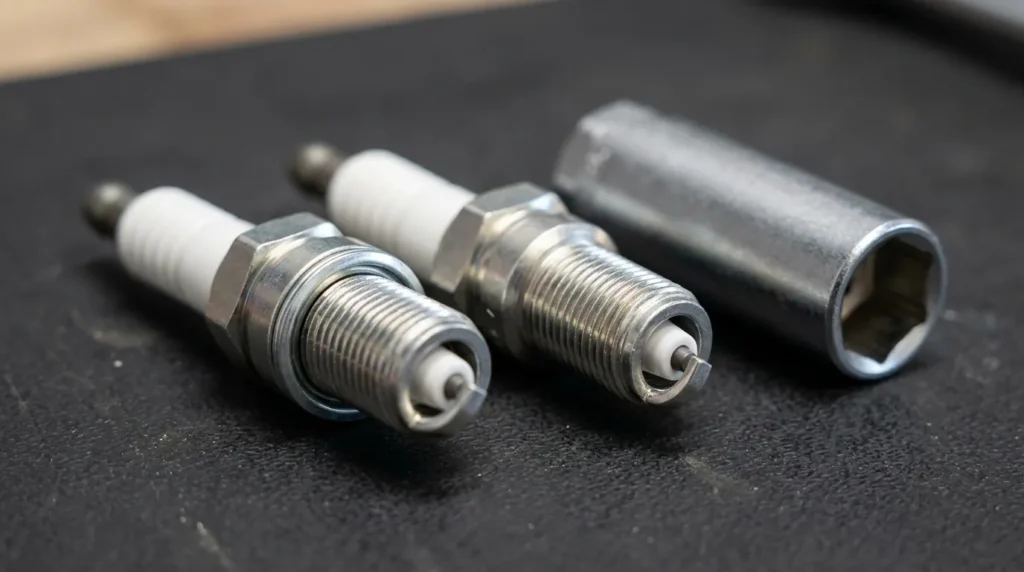
Strictly speaking, no. Spark plug makers publish a turn-angle method for installing plugs without one. But a torque wrench removes most of the guesswork, and it is the better choice in these cases:
- Aluminum cylinder heads, which are used on most modern engines. Aluminum threads strip far more easily than cast iron.
- Tapered-seat plugs, where the correct extra turn is tiny (about 1/16 of a turn) and easy to overdo by feel.
- Hard-to-reach plugs on long extensions, where it is hard to feel when the plug seats.
- When the service manual gives a torque figure, which is common on newer vehicles.
If you already own a torque wrench, our guide on how to use a torque wrench correctly covers setting and using it.
Torque wrench vs the turn method
| Point | Torque wrench | Turn method (no torque wrench) |
|---|---|---|
| What you need | 3/8-inch drive torque wrench, spark plug socket, extension | Spark plug socket and ratchet |
| Accuracy | Good, if the wrench is in calibration and used in its range | Fair; depends on starting from a clean, fully hand-seated plug |
| Best for | Aluminum heads, tapered-seat plugs, specs given in the manual | Gasket-type plugs when no torque wrench is available |
| Main risk | Using a wrench whose range is too large for the low spark plug value | Overtightening by feel, especially tapered-seat plugs |
| Where the value comes from | Service manual or plug box (torque) | Plug box (angle of rotation) |
How to install spark plugs without a torque wrench
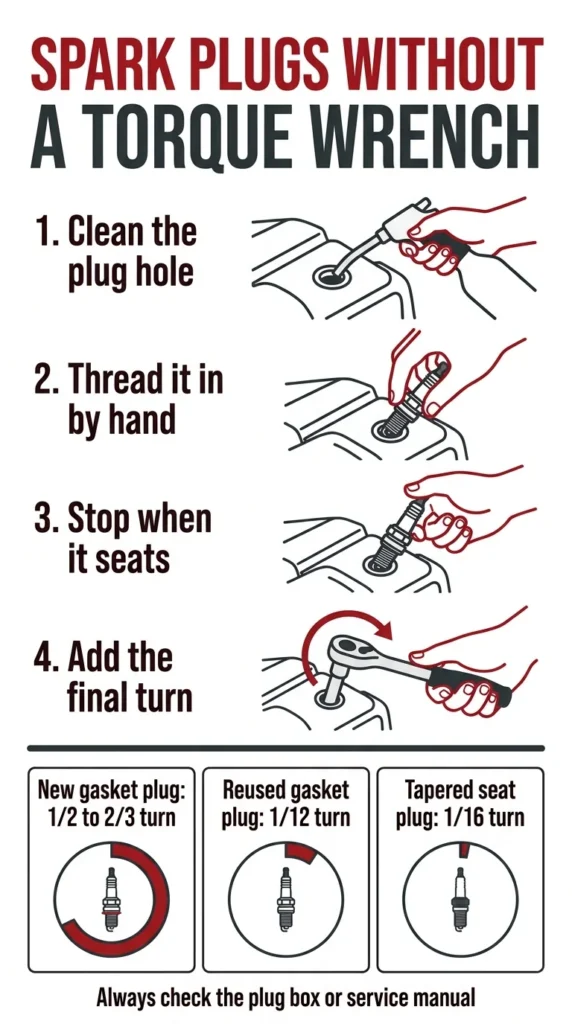
NGK’s installation guidance describes this method. The exact angle can vary by plug design, so the figure on your plug’s packaging comes first.
- Clean the hole. Blow out dirt around the plug well before removing the old plug, so debris does not fall into the cylinder. Dirt in the threads can make a plug feel tight before it is actually seated.
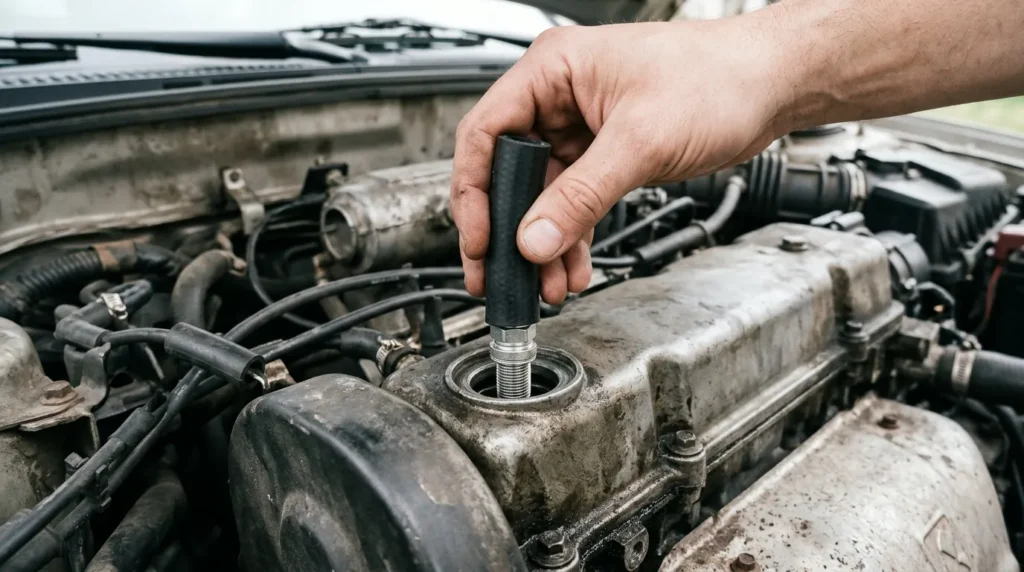
- Thread the new plug in by hand. Use the spark plug socket and an extension, or a short piece of rubber hose over the plug, and turn it with your fingers only. If it binds, back it out and start again; it is probably cross-threaded.
- Turn until it seats. Stop when the gasket or the tapered seat touches the cylinder head.
- Add the final turn with a ratchet:
- new gasket-type plug: about 1/2 to 2/3 of a turn;
- reused gasket-type plug: about 1/12 of a turn;
- tapered-seat plug (no gasket): about 1/16 of a turn.
NGK also warns against using anti-seize on its plugs unless the engine maker calls for it. Their plugs have a plated shell that already resists seizing, and NGK says anti-seize acts as a lubricant that can change torque values by up to 20 percent, which makes overtightening more likely. If your manual calls for anti-seize, follow the manual and its torque value.
What kind of torque wrench do you need for spark plugs?
Spark plug torque values are low, typically somewhere around 10 to 30 ft-lb, depending on the thread size, seat type and head material. Your manual or the plug box gives the exact value. That matters when you choose a wrench:
- Drive size: 3/8-inch drive suits spark plug sockets and the low torque range. A 1/2-inch wrench is usually too large.
- Range: click-type wrenches are most accurate away from the very bottom of their scale. Many are only rated for accuracy from about 20% of their maximum upward. A 10 to 80 ft-lb wrench is fine for a 20 ft-lb spec, but a smaller 5 to 45 ft-lb wrench is a better fit for values around 10 to 15 ft-lb.
- Type: a click-type wrench is the common, affordable choice. Our comparison of split-beam vs click-type torque wrenches explains the other option.
- Care: after use, turn a click wrench back to its lowest setting before storing it. See click torque wrench storage and calibration.
Common questions
Can I torque spark plugs without a torque wrench?
Yes, using the hand-seat-then-turn method above. It works well for gasket-type plugs. For tapered-seat plugs and aluminum heads, a torque wrench is the safer option.
Do I really need to torque my spark plugs?
Plugs need to be tightened to the right amount, whether by torque or by angle. Under-tightened plugs can run hot and loosen; over-tightened plugs can stretch or strip threads. “Tight enough by feel” is how most stripped plug threads happen.
Is hand tight OK for spark plugs?
No. Hand tight is only the starting point. Gasket-type plugs need roughly another half turn to crush the gasket and seal, and tapered-seat plugs need a small extra turn as well.
What if I already stripped the threads?
Stop and repair the threads before installing a plug. Our guide to spark plug thread repair kits explains the options. If you are not comfortable with the job, a shop can usually repair the threads without removing the head.
Torque wrenches that fit spark plug work
How we chose: we looked at 3/8-inch drive click-type wrenches on Amazon on November 18, 2026, and kept only items rated 4.5 stars or higher with at least 1,000 ratings. The details come from the makers’ listings. We have not tested these wrenches ourselves. As an Amazon Associate we earn from qualifying purchases.
1. 3/8″ Click Torque Wrench, 5 to 45 ft-lb

A small 3/8-inch click wrench with a 5 to 45 ft-lb range. Spark plug values of about 10 to 20 ft-lb sit comfortably inside that range instead of at the bottom of the scale.
Why it’s a good pick
- Range suits spark plug values
- The listing names spark plugs as a use
- About 1,200 ratings at 4.6 stars
Keep in mind
- Lesser-known brand
- Too small for lug nuts or suspension bolts
2. EPAuto 3/8-Inch Drive Click Torque Wrench

A 3/8-inch click wrench covering 10 to 80 ft-lb, which suits spark plugs around 20 ft-lb and up, plus many engine and brake bolts.
Why it’s a good pick
- About 10,200 ratings at 4.5 stars
- Covers spark plugs and general engine work
Keep in mind
- Plug values of 10 to 15 ft-lb are near the bottom of its scale
- Most lug nuts need a larger 1/2-inch wrench
3. LEXIVON 3/8-Inch Drive Click Torque Wrench (LX-182)

Another 3/8-inch click wrench with the same 10 to 80 ft-lb range, a good alternative if the EPAuto is out of stock.
Why it’s a good pick
- About 7,800 ratings at 4.5 stars
- Same range as the EPAuto
Keep in mind
- Same low-end limit as other 10 to 80 ft-lb wrenches
Bottom line
You can install spark plugs without a torque wrench if you follow the angle on the plug box and start from a clean, hand-seated plug. But a 3/8-inch torque wrench costs less than one stripped-thread repair, and it is the safer choice for aluminum heads and tapered-seat plugs. Look up the torque value in your service manual before you start.
Related guides: Spark plug maintenance tips · How to use a torque wrench correctly · Best budget torque wrenches · Ignition spark testers
Sources
- NGK Spark Plugs: Spark plug installation
- NGK Spark Plugs: How do I install spark plugs correctly?
- NGK Spark Plugs: 5 things you should know about spark plugs (anti-seize)
- Wikipedia: Torque wrench
- Wikipedia: Spark plug
- Your vehicle’s service manual and the spark plug packaging (torque or angle for your exact plug)