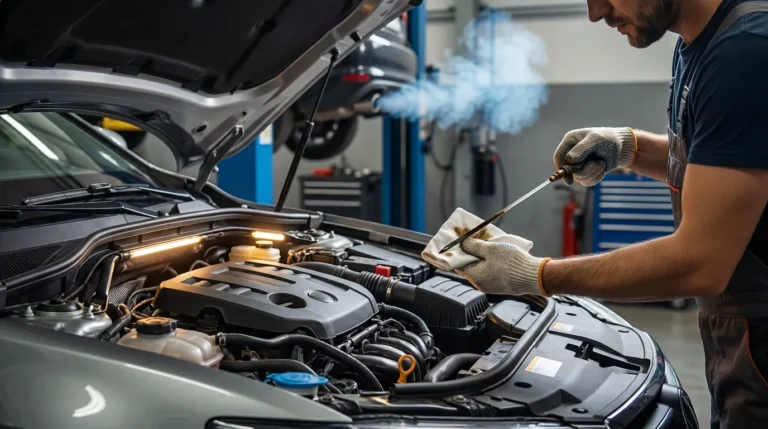
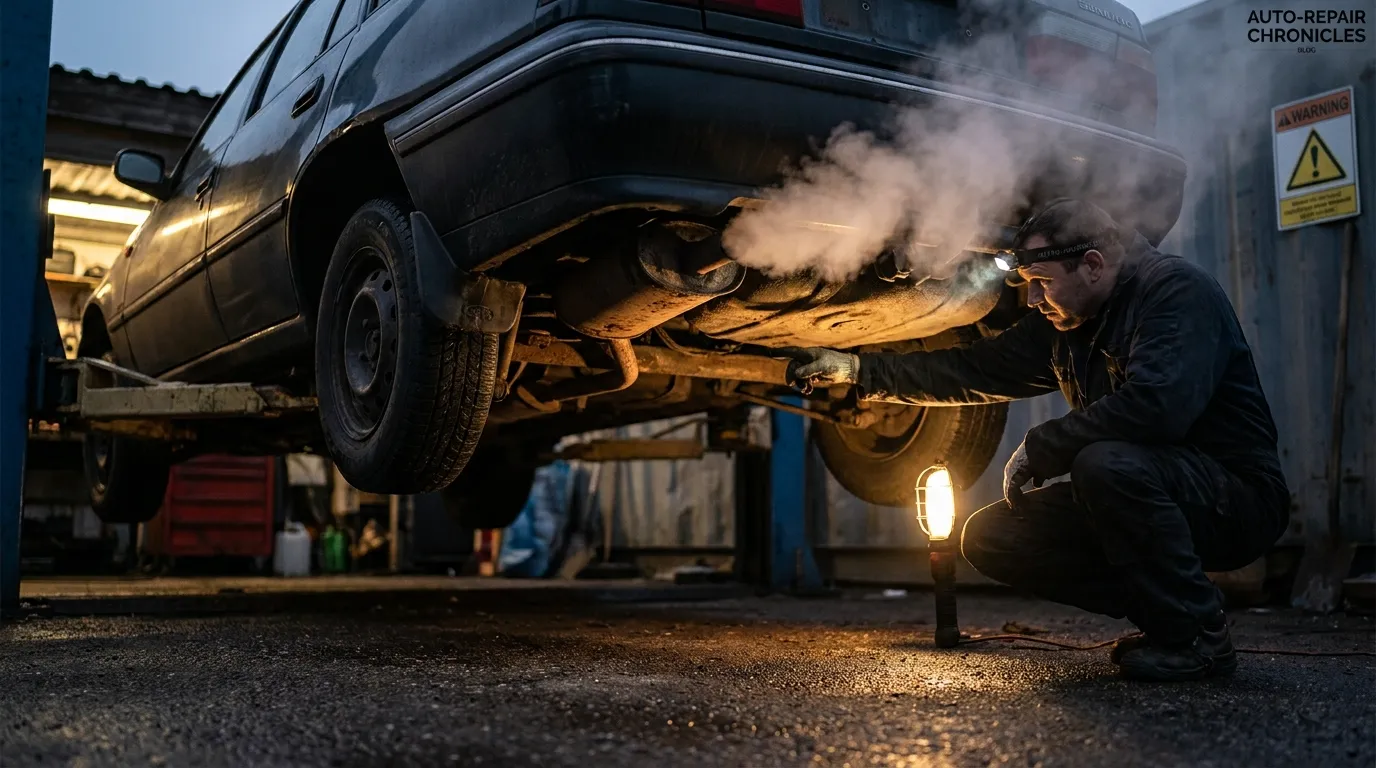
Car exhaust leak symptoms include hissing or ticking noises, exhaust smell, poor power, and soot.
If you suspect a leak, you’re not alone. I’ve diagnosed and fixed many over the years, and I know how sneaky they can be. This guide breaks down car exhaust leak symptoms in plain English. You’ll learn what to look for, why it matters, and how to act fast to protect your health, your engine, and your wallet.
What is an exhaust leak?
Your exhaust system moves hot gases from the engine to the tailpipe. It reduces noise and cleans fumes. It also keeps carbon monoxide out of the cabin. A leak means those gases escape before they reach the end.
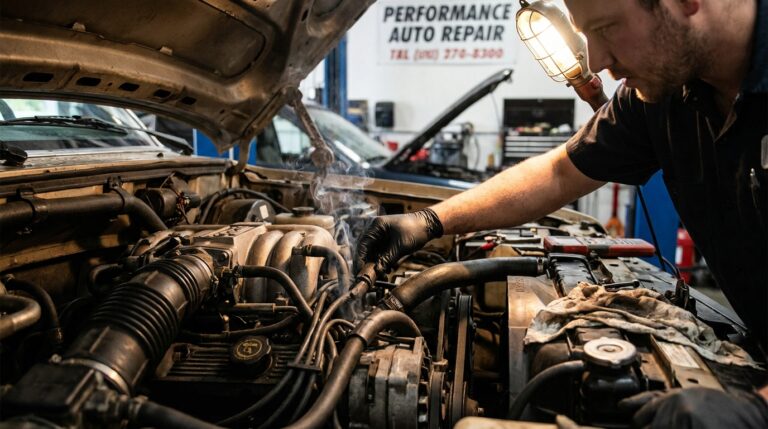
Leaks can pop up at the manifold, gaskets, flex pipe, catalytic converter, muffler, or tailpipe. They can start small. They can sound like a faint tick on a cold start. They can get worse and roar under load. Early leaks are easier to fix and cheaper too.
Think of it like a straw with a pinhole. You still sip, but you get less. The engine “breathes” the same way. A leak changes how sensors read oxygen. That confuses the fuel mix. It can hurt power, fuel economy, and emissions.

Common car exhaust leak symptoms
Spotting car exhaust leak symptoms early saves time and money. Here’s what to watch and smell for, and what you might feel while driving.
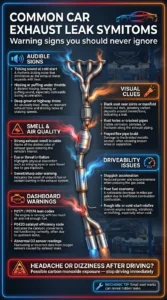
Audible signs
- Ticking at cold start that fades as metal warms. This often points to a manifold or gasket leak.
- Hissing, puffing, or chuffing under throttle. Louder near the front of the car means an upstream leak.
- Deep growl or drone on the highway. That can be a muffler, flange, or flex pipe issue.
Smell and air quality
- Strong exhaust smell near the engine bay, floorboard, or vents. If you smell fumes inside, stop and fix it soon.
- Sweet yet sharp smell with eyes or throat irritation. That’s a red flag for harmful gases.
Visual clues
- Black soot or gray streaks on flanges, manifold edges, or pipe joints. Soot marks map the leak.
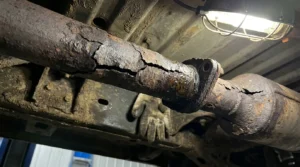
- Visible cracks, rust holes, or frayed flex braid. Look for rusted clamps and rotted seams.
Driveability
- Sluggish takeoff or flat spots when you press the gas. The O2 sensors may see extra air and skew fueling.
- Poor fuel economy. The engine may run rich to compensate for false readings.
- Rough idle or light misfire on cold start. Sealing improves as parts expand with heat.
Dashboard and scan data
- Check engine light with codes like P0171, P0174 (lean) or P0420 (catalyst efficiency). These are common with upstream leaks.
- O2 sensor activity looks wrong on a scan tool. Short-term fuel trim swings may be large.
Safety symptoms
- Headache, dizziness, or nausea after driving. This can be carbon monoxide exposure. Park and get help now.
Personal note: I once traced a faint tick to a cracked manifold on a daily driver. It only showed cold. The clue was tiny soot by the middle runner. Fixing it quieted the engine and restored pep. Small car exhaust leak symptoms can hide in plain sight.
Why exhaust leaks matter: health, performance, and damage
Health risks
- Carbon monoxide is odorless and deadly. Even small leaks can seep into the cabin at idle or in traffic.
- Vent recirculation can pull fumes inside. Kids and pets are extra vulnerable.
Performance and emissions
- False oxygen readings cause lean or rich mix. That hurts power and miles per gallon.
- You can fail a state emissions test due to diluted sensor readings or visible leaks.
Component damage
- Hot gas jets can burn nearby wires, boots, and plastic. I’ve seen O2 sensor wires melted by a pinhole.
- Prolonged rich running can kill a catalytic converter. That is a big-ticket part.
Legal and noise
- Many areas ban loud exhaust and tampering. A leak can cross that line fast.

How to diagnose car exhaust leak symptoms at home
Start safe
- Work outside or in a well-vented area. Keep a fire extinguisher nearby.
- Wear gloves and eye protection. Hot parts can burn skin.
Listen and feel
- Cold start test. Stand by the engine bay. Listen for a tick that fades as it warms.
- Use a short hose as a stethoscope. One end to your ear, one end to suspect joints. Move slowly.
- With the car cool and idling, hold your hand near flanges and seams. Feel for sharp pulses. Do not touch hot parts.
Soapy water test
- Mix dish soap and water in a spray bottle. Spray on suspect joints when the system is cool.
- Briefly start the car. Watch for bubbles forming. Shut off right away. Bubbles mark the spot.
Rag test
- With a helper, gently cover the tailpipe with a rag for 2–3 seconds. Backpressure will push leaks to show.
- Listen for louder hissing. Do not hold it long. Avoid damage.
Scan tool hints
- Plug in a basic OBD2 scanner. Look for lean codes (P0171/P0174) or P0420.
- Watch short- and long-term fuel trims. High positive trims at idle that drop at higher RPM can mean an upstream leak.
When to stop and call a pro
- If you smell fumes in the cabin or get lightheaded, stop now.
- If the leak is near the manifold or studs, rust can make the job tough. A shop has heat and tools to extract bolts.
Tools that help
- Spray bottle with soapy water, flashlight, gloves, hose for listening, basic OBD2 scanner.
- A smoke machine is great but optional. Many shops offer smoke tests.
Personal insight: The rag test has helped me find dozens of leaks fast. I use it for 2 seconds tops. It makes small leaks “whistle” under light backpressure. Simple, cheap, and effective.
Quick PAA-style answers
How loud is an exhaust leak?
It can be a faint tick on cold start or a harsh hiss on throttle. Louder leaks often sit closer to the engine.
Will an exhaust leak go away on its own?
No. Heat cycles and rust make it worse over time. Fix early to avoid bigger repairs.
Can an exhaust leak trigger a misfire?
Yes. Upstream leaks can skew fuel mix and cause rough idle. Fixing the leak can smooth the engine.
Common leak locations and causes
Upstream (before the catalytic converter)
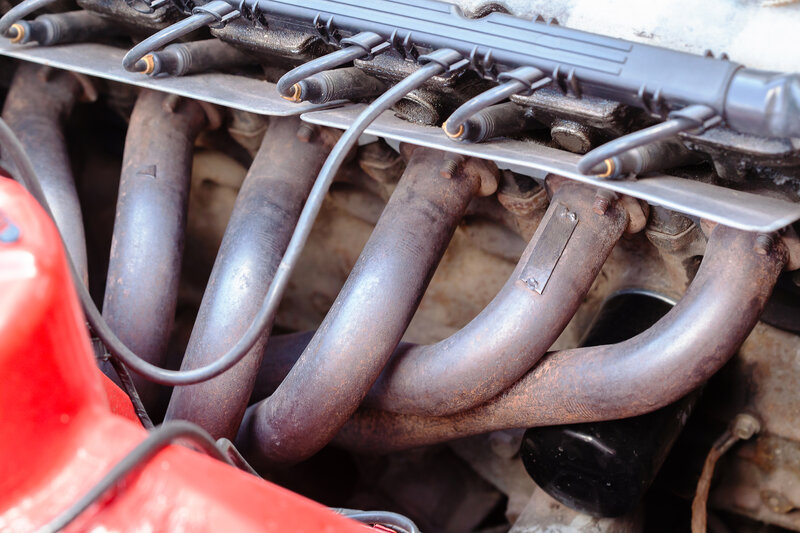
- Exhaust manifold cracks or warped flange. Often from heat stress or broken mounts.
- Manifold gasket leaks. Look for soot at cylinder edges.
- Donut gasket at the manifold-to-pipe joint. Wear and movement cause leaks.
- Flex pipe fray or split. Age, salt, and engine rock tear the braid.
Mid-system
- Flange gaskets near the catalytic converter. Rust at the weld lip is common.
- Converter shell or seams. Impact or corrosion can split thin spots.
Rear section
- Muffler seams rust out and weep black water and soot.
- Tailpipe joints and hangers. Broken hangers add stress and crack pipes.
Root causes
- Road salt, moisture from short trips, and thin steel.
- Engine mount failure that twists the exhaust.
- Misfires or raw fuel overheating the system.
- Poor-quality clamps or past patch jobs.
Tip from the bay: After winter, I always check the flex pipe and rear seams. Salt spray loves those spots. If I see fresh soot or a wet black drip from the muffler, a pinhole is near.
Source: allbaydiesel.com
Repair options, costs, and timelines
Temporary fixes
- Exhaust repair tape or paste can seal pinholes for a short time. Good to get you home.
- Band clamps can bridge small gaps at joints. Use as an interim fix.
Permanent repairs
- Replace gaskets, flanges, or sections of pipe. Weld or bolt with quality parts.
- Swap cracked manifolds or damaged flex pipes. Use new hardware and O2 sensor-safe anti-seize.
- Replace failed catalytic converters or mufflers if rusted beyond repair.
Typical costs (parts and labor vary by region and vehicle)
- Manifold gasket: 1–3 hours. About $150–$600.
- Exhaust manifold: 2–6 hours. About $300–$1,500+ depending on access.
- Flex pipe weld-in: 1–2 hours. About $100–$400.
- Muffler replacement: 1–2 hours. About $150–$500.
- Catalytic converter: 1–3 hours. About $800–$2,500+.
- Diagnostic smoke test: About $50–$150.
Timeframes
- Simple clamp or gasket: same day.
- Rusted studs or seized bolts: add time for extraction.
- Complex manifolds on V engines may need extra labor.
Buyer’s note: I prefer stainless steel parts and OEM-style gaskets. They last longer and fit right. That reduces comebacks and noise.
Prevention and maintenance tips
Drive and care habits
- Take a 20-minute highway run weekly. It dries out moisture in the muffler.
- Wash the undercarriage after salt or beach trips. Salt speeds rust.
Routine checks
- Inspect hangers and mounts every oil change. Replace broken rubber right away.
- Look for soot near joints and flanges. Catch small leaks before they grow.
- Fix misfires quickly. Raw fuel can overheat and crack parts.
Parts and install
- Use anti-seize on studs and torque to spec. It helps the next tech and prevents warp.
- Choose stainless or aluminized steel when you can. It resists rust.
Cabin safety
- If you ever smell fumes inside, switch to fresh air and roll windows down. Stop soon and diagnose.
From experience: After fixing car exhaust leak symptoms, I recheck the job in a week. Heat cycles can loosen clamps. A quick snug prevents a return visit.

Frequently Asked Questions of car exhaust leak symptoms
Can I drive with an exhaust leak?
You can, but it is risky. Fumes can enter the cabin, and you may damage the catalytic converter over time.
Will a car with an exhaust leak pass emissions?
Often no. Leaks can cause false sensor readings and high emissions, leading to a failed test.
How do I know if the leak is before or after the catalytic converter?
Harsher ticking near the engine and lean codes suggest an upstream leak. A deeper drone from the rear points downstream.
Do car exhaust leak symptoms include a check engine light?
Yes. Common codes are P0171/P0174 for lean mix and P0420 for catalyst efficiency. A scan tool helps confirm.
Can an exhaust leak hurt fuel economy?
Yes. The engine may run rich or lean due to false readings. Many drivers see a 5–15% drop until fixed.
Is the exhaust smell always strong with a leak?
Not always. Small leaks can be odorless inside the cabin but still dangerous. Carbon monoxide has no smell.
Why do leaks sound louder on cold start?
Metal contracts when cool and expands with heat. Gaps are larger when cold, so leaks are louder then.
Conclusion
Car exhaust leak symptoms are your early warning. Listen for ticks, watch for soot, and trust your nose. Fast action protects your health, saves fuel, and stops bigger bills later. If you catch a leak early, the fix is simple and often cheap.
Take the next step today. Do the cold start check, scan for codes, and inspect joints. If you’re unsure, book a smoke test with a trusted shop. Want more step-by-step guides like this? Subscribe for updates or drop your question in the comments.