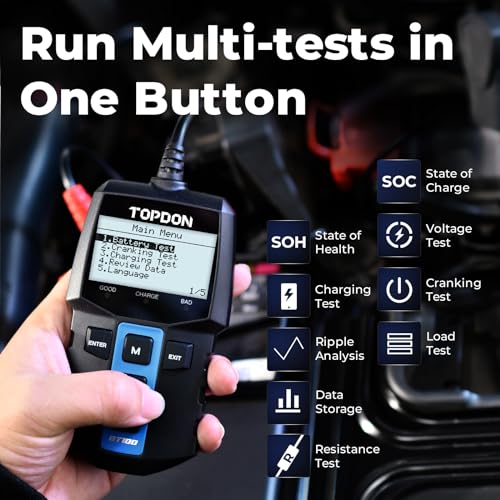
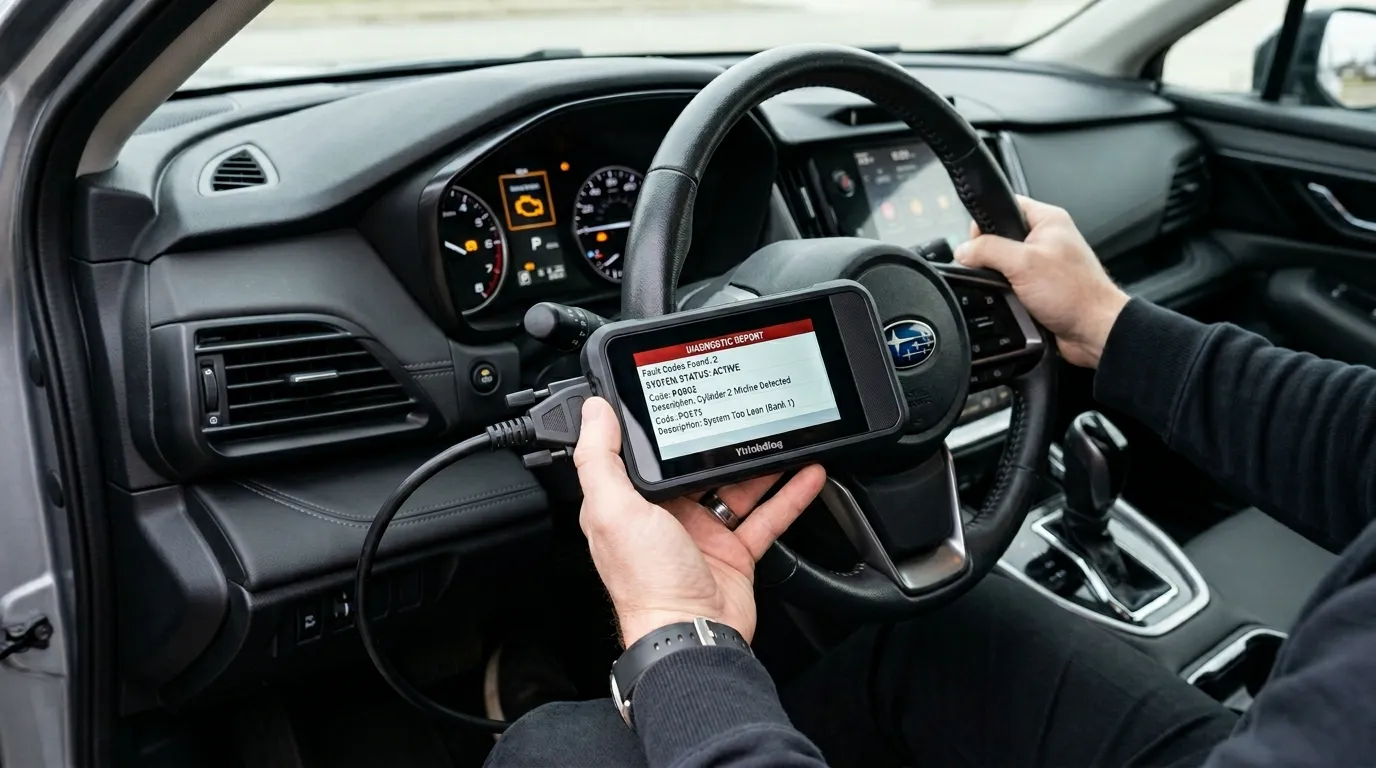
Plug a scanner into the OBD2 port, read the codes, then look them up and fix the issue.
I’ve worked on cars and helped many people learn how to read obd2 codes. This guide shows simple steps, real examples, and clear tips. You will learn what codes mean, how to scan safely, and when to ask a pro. My aim is to make how to read obd2 codes easy, useful, and practical for everyday drivers and DIYers.
Why OBD2 codes matter
OBD2 codes tell you why a warning light is on. They point to system faults in the engine, transmission, or emissions. Learning how to read obd2 codes saves time and money. You can avoid guesswork and fix the right problem faster.
What OBD2 codes are and how they’re structured
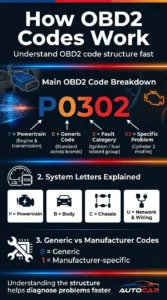
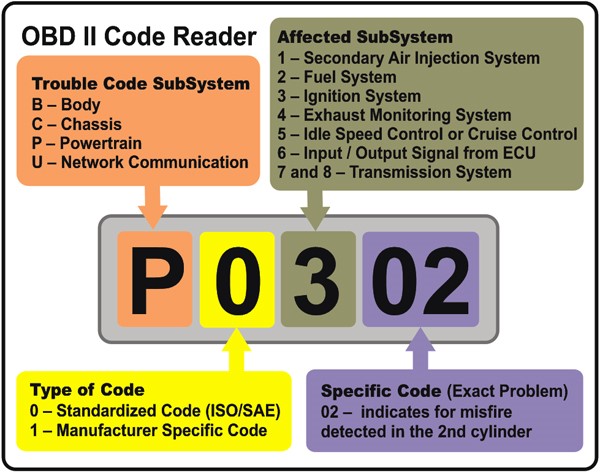
OBD2 codes are standardized trouble codes. Each code has five characters. The first letter shows the system:
- P means powertrain (engine and transmission)
- B means body
- C means chassis
- U means network or wiring
The second character shows if the issue is generic or maker-specific:
- 0 means generic
- 1 means manufacturer specific
The last three digits give the exact fault. For example, P0302 means cylinder 2 misfire. Knowing this structure helps when you learn how to read obd2 codes and interpret results quickly.
How to read OBD2 codes — step-by-step
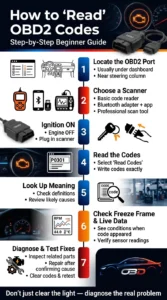
- Locate the OBD2 port
- The port is usually under the dash near the steering column.
- Some models hide it behind a cover or in the center console.
- Choose a scanner or adapter
- Use a simple code reader for basic checks.
- Use a Bluetooth adapter plus an app for deeper live data.
- Use a professional scan tool for complex jobs.
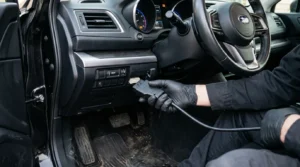
- Turn the ignition on (engine off) and plug in
- Power the scanner with the key in the ON position.
- Follow the scanner prompts to connect.
- Read the codes
- Select Read Codes on the device or app.
- Write down each code exactly as shown.
- Look up code meaning
- Use the scanner’s built-in list or a reliable code database.
- Read the definition and likely causes.
- Check freeze frame and live data
- Freeze frame shows conditions when the code set.
- Live data helps confirm sensor values and symptoms.
- Diagnose and test fixes
- Inspect parts related to the code.
- Replace or repair only after confirming the cause.
- Clear codes and test drive. If the code returns, dig deeper.
How to read obd2 codes is about steps and checks, not just clearing a light. Follow the steps above for a safe and accurate diagnosis.
Quick PAA-style questions
What if the code is manufacturer-specific?
Manufacturer-specific codes need maker documentation or a full scan tool. They often require service manuals or forums for exact causes.
Can I clear codes without fixing the car?
Yes, but the light will likely come back if the issue remains. Clearing codes masks the symptom but does not fix root causes.
Do all cars use the same OBD2 codes?
All cars since 1996 (in the US) follow OBD2 standards for most codes, but some codes are manufacturer-specific. Knowing how to read obd2 codes helps you spot the difference.
Common OBD2 codes and what they mean
P0300 Random/multiple misfire detected
- Engine misfires under load or at idle.
- Causes include spark plugs, coils, fuel, or vacuum leaks.
P0171 System too lean (bank 1)
- Air/fuel mix has too much air.
- Check MAF sensor, fuel pressure, and vacuum leaks.
P0420 Catalyst system efficiency below threshold
- Catalytic converter or oxygen sensors may be bad.
- Check exhaust leaks and sensor performance before replacing the cat.
P0113 Intake air temperature sensor high input
- Sensor reads too hot or is open.
- Inspect wiring and the IAT sensor.
U0100 Lost communication with ECM/PCM
- The main module is not talking on the network.
- Check fuses, wiring, and module power.
These examples show why learning how to read obd2 codes matters. A code is a starting point, not the full story.
Tools and apps for reading OBD2 codes
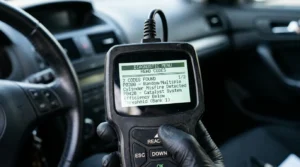
- Basic code reader
- Plugs in, shows codes, and clears lights. Good for first checks.
- Bluetooth OBD2 adapter plus phone app
- Affordable and powerful. Shows live data, freezes, and graphing.
- Professional scan tool
- Read deep codes, module programming, and advanced tests. Best for techs.
- Laptop software and data loggers
- For advanced tuning or repeated testing. Use when you need detailed logs.
When picking tools, match the tool to your skill and needs. If you want to learn how to read obd2 codes deeply, get an adapter and a quality app.
Practical tips, mistakes to avoid, and real-life examples
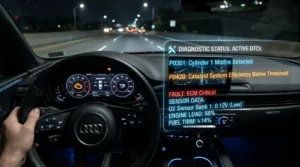
Tip: Always record codes before clearing them. I once cleared a P0300, only to lose the freeze frame that showed a bad injector pulse. That cost me time and a replacement part. Recording codes helps save time.
Avoid these mistakes:
- Do not replace parts based only on the code.
- Do not assume one code means only one cause.
- Do not ignore wiring and connectors.
Real-life example: I helped a friend whose check engine light showed P0171. We cleaned the MAF sensor and found a vacuum hose cracked. Fixing both stopped the light. That’s how to read obd2 codes with common sense — combine data with inspection.
Source: totalcardiagnostics.com
Limitations and when to seek a pro
OBD2 codes point to symptoms, not always the root cause. Complex faults can involve wiring, intermittent issues, or calibration. Seek a professional when:
- Multiple modules show communication errors.
- You need module reprogramming.
- The issue is intermittent or safety-related.
Knowing how to read obd2 codes helps you decide when to DIY and when to hire a shop.
Frequently Asked Questions of how to read obd2 codes
What is the easiest way to read OBD2 codes?
Use a simple OBD2 scanner or a Bluetooth adapter with a phone app. Plug in, use the app to read codes, and look up meanings.
Will clearing codes fix the problem?
No. Clearing codes only removes the symptom temporarily. Fix the root cause to prevent the light from coming back.
Can I drive with a check engine light on?
You can often drive short distances, but take care. If the light flashes or the car runs poorly, stop and get service.
Do all OBD2 scanners show the same details?
No. Basic scanners show codes and definitions. Advanced tools show live data, freeze frame, and module info.
How long after a repair will the code clear?
If the repair fixes the issue, the code may clear after several drive cycles. You can also clear codes manually, then verify the fix by test driving.
Conclusion
You can learn how to read obd2 codes with a simple scanner, smart app, and step-by-step checks. Start by reading codes, look up meanings, inspect parts, and test fixes. Be curious and patient. Try a basic scan on your car today, note the codes, and use this guide to take the next step. Share your results, ask questions, or subscribe for more hands-on car tips.