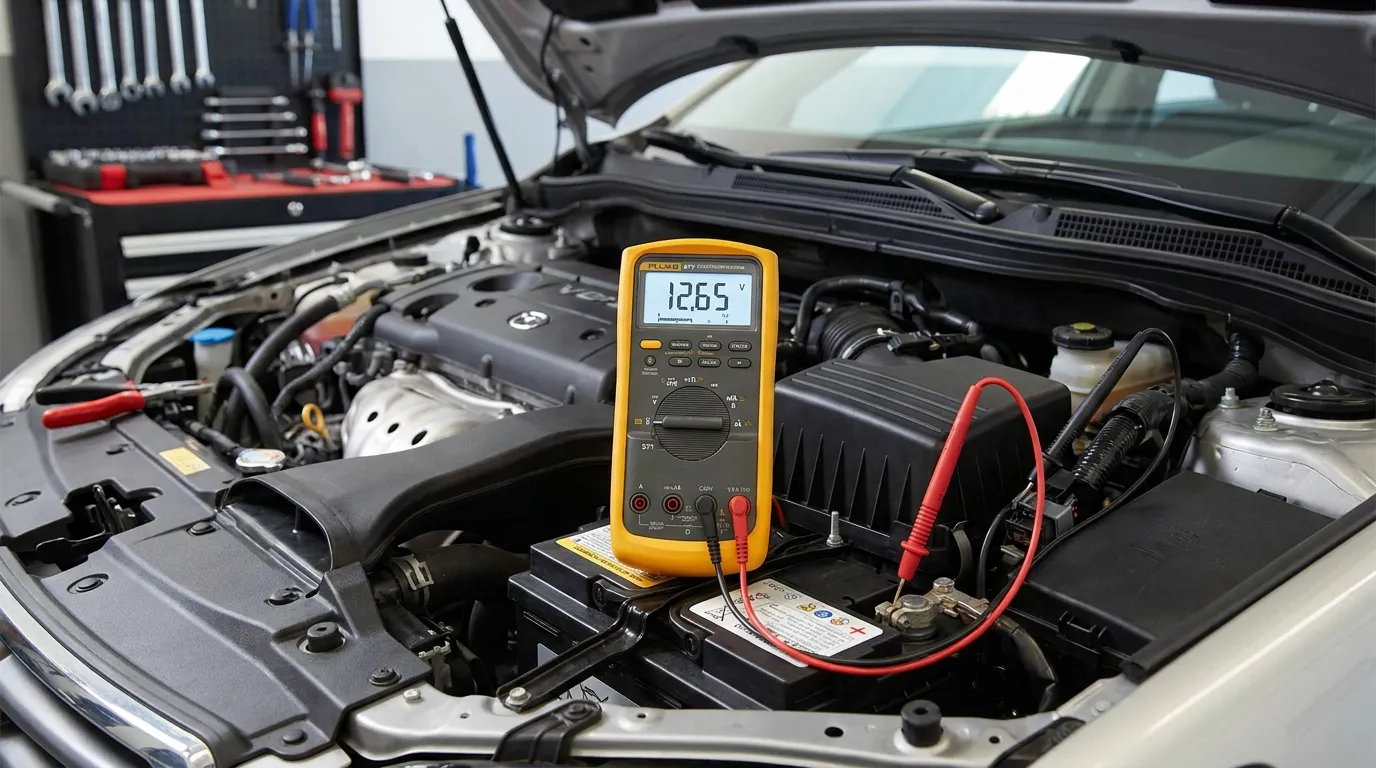
Set multimeter to DC volts, probe battery posts, read 12.6V+ charged, 13.7–14.7V running.
If you want a clear, no-jargon guide on how to use multimeter for car battery, you’re in the right place. I’ve tested hundreds of batteries in driveways and shops. This guide shows you exactly what to do, what numbers matter, and what they mean. You’ll learn how to use multimeter for car battery checks at rest, while cranking, and with the engine running, so you can spot weak cells, bad cables, or a failing alternator fast.

What a Multimeter Measures and Why It Matters
A multimeter reads voltage, current, and resistance. For car batteries, voltage is the star. It tells you the state of charge and hints at battery health. It also helps you check the alternator and wiring.
A healthy 12-volt lead-acid battery rests near 12.6 volts at about 77°F. That is chemistry talking, not guesswork. If your number is far lower, the engine may crank slow or not at all. If it is too high when running, you could cook the battery.
Knowing how to use multimeter for car battery makes all of this simple. You get data in seconds and avoid guesswork.
I learned this the hard way on a road trip. A quick test showed 12.1 volts at rest. I charged the battery before bed and saved a tow call in the morning.

Safety First: Prepare Your Car and Tools
Working around a battery is safe if you follow a few basics.
- Park on level ground and set the parking brake. Turn the engine off and remove the key.
- Wear eye protection and gloves. Batteries can vent gas and acid.
- Keep metal tools away from both posts at the same time. Avoid short circuits.
- Work in fresh air. No flames or sparks near the battery.
- If your car is a hybrid or has a 48V system, do not touch high-voltage parts. This guide covers a 12V battery only.
These steps take one minute and prevent big problems later.
Source: com.au
Step-by-Step: How to Use Multimeter for Car Battery at Rest
This is your base test. Do it first. The car should sit with the engine off for at least 30 minutes. That lets surface charge settle.
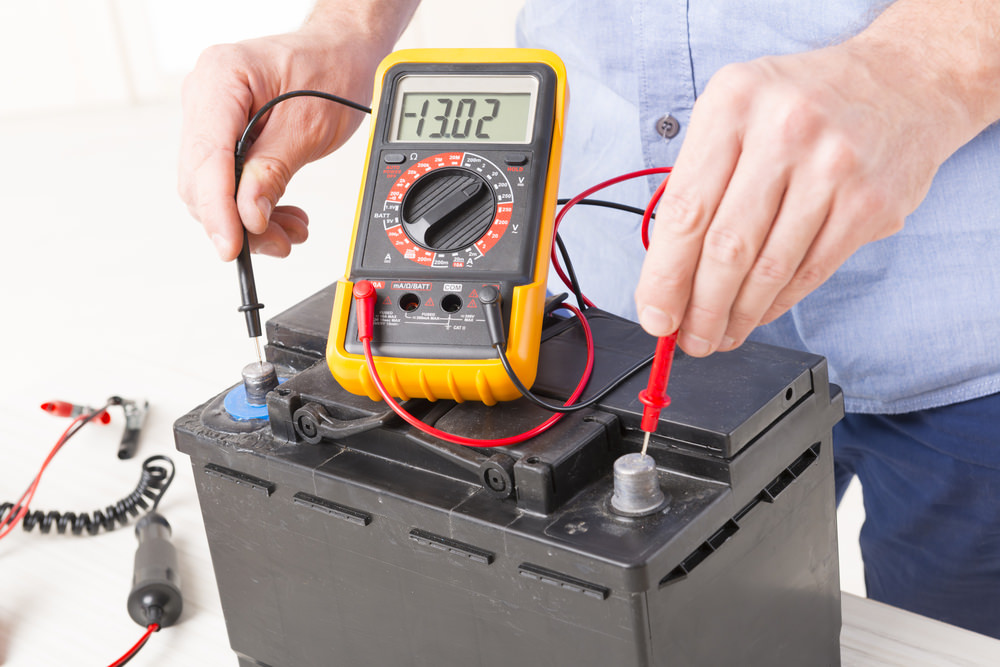
- Set your multimeter to DC volts. If it has ranges, choose 20V DC.
- Touch the red probe to the battery positive post. It is marked with a plus sign.
- Touch the black probe to the negative post.
- Read the voltage and write it down.
How to read the number
- 12.6–12.8V means fully charged.
- 12.4–12.5V means about 75% charged.
- 12.2–12.3V means about 50% charged.
- 12.0–12.1V means about 25% charged. Charge soon.
- Below 11.8V means very low or bad cell. Charge and retest.
Tips to improve accuracy
- Cold weather lowers the reading a bit. Hot weather raises it a bit.
- If you just drove, turn off the car and wait 30 minutes. Or turn the headlights on for one minute, off, then test.
- If the clamps or posts are dirty, clean them first.
This simple check is the core of how to use multimeter for car battery. It gives you a clear snapshot of charge and health in seconds.

Cranking Test: Battery Under Load
Now see how the battery behaves when the starter draws big current. This shows real muscle, not just a resting number.
- Have a helper watch the multimeter while you start the car. Keep the probes on the posts.
- Crank the engine for 3–5 seconds. Stop if it starts.
- Note the lowest voltage seen during the crank.
What to look for
- 9.6V or higher during cranking at about 70–80°F is good.
- 8–9.5V means weak battery or heavy draw. Charge and retest.
- Below 8V often points to a failing battery, bad cell, or very high resistance at cables.
Pro tip from the field
I once chased a “bad” battery that dipped to 8.7V on crank. The real issue was a corroded ground strap. After cleaning and tightening, crank voltage rose to 10.1V and the car fired like new. Do not skip cable checks.
Note: Very cold weather thickens oil and drops crank voltage. Warm climates do the opposite.
Charging System Test: Alternator Output and Ripple
A charged battery is great, but it needs a healthy alternator to stay that way. This quick test shows if the alternator is doing its job.
- Start the engine and let it idle. Keep the probes on the posts.
- Read charging voltage. Normal is about 13.7–14.7V for most cars.
- Turn on loads like headlights, rear defog, and blower fan. Voltage should stay above about 13.4V.
What numbers mean
- Below 13.2V at idle with loads often means weak alternator or belt slip.
- Above 15.0V can point to a bad regulator. Overcharge can damage the battery.
AC ripple check
- Set the meter to AC volts. Keep probes on the battery posts with the engine running.
- You want a small number, often below 0.1–0.3V AC.
- A high AC value can mean a bad alternator diode and poor charging.
Many drivers search how to use multimeter for car battery, but forget the alternator. Check both to protect your time and wallet.

Common Mistakes to Avoid with a Multimeter
A few small errors cause big confusion. Skip these traps.
- Using the wrong meter setting. Use DC volts for all battery and alternator checks.
- Swapping probe jacks. Do not leave the red lead in the current (A) port when measuring voltage. You can blow a fuse in the meter.
- Touching both posts with a metal tool. That can spark or short your battery.
- Guessing with the hood up. Always write down your numbers. Then compare and decide.
- Measuring current by placing the meter across the battery posts. That is a short. Current is a series test and not covered here.
Knowing how to use multimeter for car battery also means knowing what not to do. It keeps you safe and protects your tools.

Troubleshooting Scenarios and What Your Reading Means
Use your numbers to guide next steps. Here are common cases I see.
If resting voltage is low but climbs above 13.7V when running
- The battery is likely fine but needs a full charge. Drive longer or use a smart charger.
- Check for lights left on or short trips only.
If resting is fine but cranking dips under 9V
- Battery may be weak. Clean and tighten all terminals first.
- Check engine grounds. Look for corrosion or loose straps.
If running voltage is under 13V
- Suspect the alternator, belt, or wiring.
- Check the belt for slip. Listen for squeal. Inspect the plug at the alternator.
If running voltage is over 15V
- Regulator may be bad. Overcharge can boil fluid and shorten life.
- Do not delay. Fix before the battery swells or vents.
If battery reads fine but dies overnight
- You may have a parasitic draw. A dome light or module may stay awake.
- This is where many ask how to use multimeter for car battery to find a drain. That is a current test with the meter in series and takes care. If unsure, see a pro.

Extra Tips, Tools, and When to Seek Help
Small habits extend battery life and reduce surprises.
- Use a smart charger if the car sits for weeks. This keeps voltage near 12.6–12.8V without overcharge.
- Clean posts and clamps twice a year. A wire brush and baking soda mix work well.
- Know your battery type. AGM and flooded lead-acid prefer slightly different charge profiles.
- Check the date code. Many batteries last 3–5 years. Past that, test often.
- Do not trust only the dash readout. Verify with a meter.
- Most parts stores can do a free load test. Use that if numbers seem odd.
As you learn how to use multimeter for car battery, you will spot patterns. Your readings tell a clear story long before a no-start morning.

Frequently Asked Questions of how to use multimeter for car battery
What is the best multimeter setting for a car battery?
Use DC volts, often marked V with a straight line. If your meter has ranges, pick 20V DC to cover a 12V system.
How often should I check my car battery with a multimeter?
Check before a long trip, at season changes, and every few months. If the car cranks slow, test right away.
Can I test a car battery without removing it?
Yes. You can test at the battery posts or jump terminals under the hood. Make sure you have good contact on clean metal.
What voltage is too low to start a car?
Below about 12.0V at rest is risky for a start. If it drops under 9.6V while cranking at room temp, the battery may be weak.
Will a bad alternator still show 12.6V at rest?
Yes. A resting battery can read 12.6V even if the alternator is bad. Start the engine and check for 13.7–14.7V to confirm charging.
How do cold temps change the numbers?
Cold lowers resting voltage a bit and raises cranking load. A weak battery that starts in summer may fail in winter.
Is it safe to test an AGM battery the same way?
Yes for voltage tests. Just note that AGM batteries may show slightly higher resting voltage when fresh and fully charged.
Can I use a cheap multimeter for car tests?
Yes. Even a basic meter reads voltage well enough. Accuracy within 0.1V is fine for these checks.
Conclusion
You now know how to use multimeter for car battery testing with confidence. Check voltage at rest, watch the drop during cranking, and confirm alternator output while running. These three snapshots tell you if the battery, cables, or charging system need help.
Put this into practice today. Grab your meter and record your numbers. If anything looks off, clean connections, charge the battery, and retest. Want more DIY guides like this? Subscribe, share your readings, or drop a question in the comments so we can troubleshoot together.