
Both AGM and “standard” car batteries are lead-acid batteries. The difference is how the acid is held inside. A standard battery is a flooded (wet-cell) battery: its plates sit in liquid acid. An AGM (absorbent glass mat) battery holds the same acid soaked into fiberglass mats, so it is sealed and spill-proof. That one design change affects price, lifespan, cold starting and which cars each battery suits.
Quick answer
AGM batteries cost more, often around 40–100% more than a flooded battery of the same size, but they usually last longer, recharge faster, handle vibration and deep discharges better, start well in the cold and never need topping up. Flooded batteries are cheaper and work well in older cars with modest electrical loads. If your car came with an AGM battery, replace it with an AGM. Start-stop cars and cars with many electronics depend on it. If your car came with a flooded battery, either type will work: an AGM is an upgrade, not a requirement. Check the battery type, group size and cold cranking amps (CCA) in your owner’s manual.
In this guide
AGM vs flooded lead-acid at a glance
| AGM | Flooded (standard) lead-acid | |
|---|---|---|
| How the acid is held | Absorbed in glass-fiber mats; sealed | Liquid acid around the plates |
| Price | Higher | Lower |
| Typical lifespan | Often about 4–7 years | Often about 3–5 years |
| Maintenance | None; can’t be topped up | Some types need distilled water checks |
| Cold starting | Usually stronger for its size | Good, but drops more in deep cold |
| Deep discharge and cycling | Handles it better | Repeated deep drains shorten its life |
| Vibration and spills | Very resistant; spill-proof | Less resistant; can leak if tipped |
| Start-stop cars | Required by many | Not suitable (EFB is the flooded option) |
| Charging | Needs correct voltage; use an AGM mode | Tolerates basic chargers better |
Lifespans vary a lot with climate, driving pattern and charging. Heat and short trips shorten any battery’s life.
What is an AGM battery?
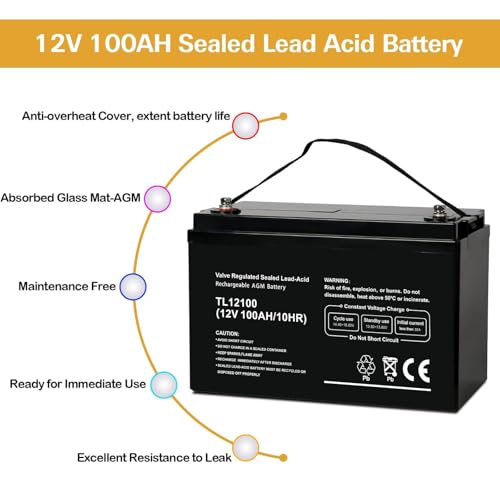
AGM stands for absorbent glass mat. Thin fiberglass mats sit between the lead plates and hold the electrolyte like a sponge. The battery is sealed and uses a pressure valve, which is why AGM batteries are also called valve-regulated lead-acid (VRLA) batteries. Gases recombine inside rather than venting, so there is no water to top up and no liquid to spill.
The plates are packed tightly, which lowers internal resistance. In practice that means strong bursts of current for starting, faster recharging, and better tolerance of the frequent charge and discharge cycles that start-stop systems create.
What is a flooded lead-acid battery?
A flooded battery is the traditional car battery: lead plates in a bath of sulfuric acid and water. Many are sold as “maintenance-free”, meaning the caps are sealed and you don’t add water, while others have removable caps so the level can be checked. They are cheap, widely available and perfectly good for cars that came with them.
Their weak points are deep discharges (leaving the lights on can permanently reduce capacity), heavy vibration, and high electrical demand. An EFB (enhanced flooded battery) is a tougher flooded design used in some entry-level start-stop cars. It sits between a standard flooded battery and an AGM.
Which one does your car need?
- Your car came with an AGM: stay with AGM. Start-stop systems, regenerative braking and battery monitoring are designed around it, and a flooded battery will wear out quickly and can cause electrical warnings.
- Your car came with an EFB: use an EFB or upgrade to an AGM.
- Your car came with a flooded battery: a flooded battery is fine. An AGM is worth it if you have extra electrical loads (a big audio system, a winch, a dash cam running while parked), live somewhere very cold, drive mostly short trips, or the car sits for long periods.
Many newer cars, especially European models, have a battery monitoring system. After fitting a new battery they may need the battery “registered” or coded with a scan tool so the car charges it correctly. Your owner’s manual or a dealer can confirm this.
Lifespan and cost: is AGM worth it?
An AGM costs more up front but often lasts a year or two longer and copes better with modern electrical loads. Over its life the cost per year can be similar to a flooded battery. In an older car with basic electrics that you drive regularly, a good flooded battery is usually the better value. In a car with start-stop, lots of electronics or a hard life of short trips, AGM is usually worth it, and often required.
Whichever you choose, the biggest factors in how long it lasts are heat, short trips and being left discharged. See how long a car battery lasts and how to maintain a car battery for ways to get the most from it.
Charging and testing AGM batteries
- Use a smart charger with an AGM mode. AGM batteries can be damaged by overcharging or by old chargers with no voltage control. See what a car battery charger does.
- For a car that sits for weeks, a maintainer keeps the battery full without overcharging. See trickle charger vs battery maintainer.
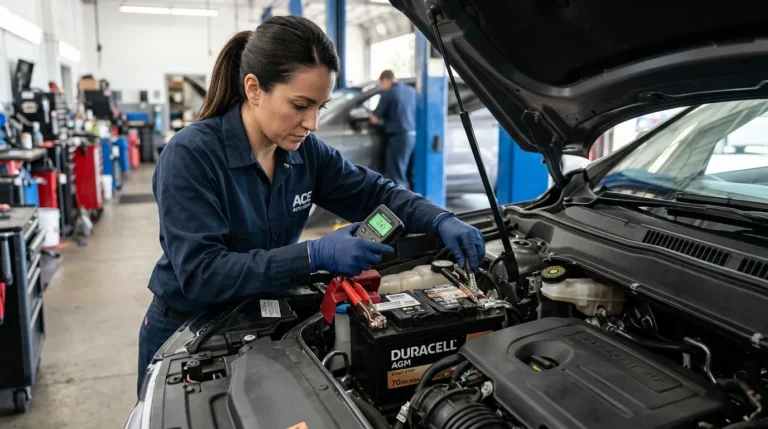
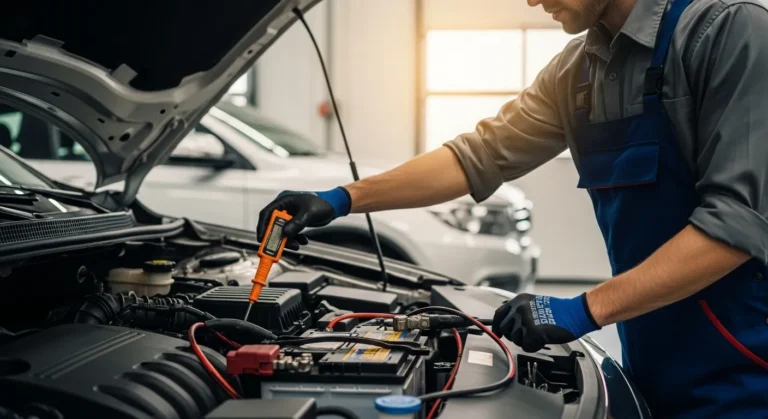
- A fully charged 12 V battery of either type reads about 12.6–12.8 V at rest. Use a tester that has an AGM setting for accurate results: battery testers for AGM batteries.
Signs it’s time to replace either type
- Slow cranking, especially on cold mornings.
- A battery warning light, or dim lights at idle.
- A swollen case, leaks or a rotten-egg smell (stop using it).
- A battery that keeps going flat. Rule out a drain or charging problem first: why a car battery keeps dying.
More warning signs are in signs of a bad car battery.
Related guides: best car battery for SUV and lithium vs lead acid jump starter.
Frequently Asked Questions
Is an AGM battery a lead-acid battery?
Yes. AGM is a type of sealed lead-acid battery. The difference from a standard battery is that the acid is held in glass mats instead of being free liquid.
Can I replace an AGM battery with a regular battery?
It isn’t recommended. Cars that came with AGM, especially start-stop cars, are designed around it. A flooded battery will usually wear out much sooner and may trigger warnings.
Can I put an AGM battery in a car that came with a flooded battery?
Usually yes, as long as the group size, terminal layout and CCA match. Most charging systems handle AGM fine. Check your owner’s manual if you’re unsure.
Do AGM batteries last longer than lead-acid batteries?
Generally yes, often about 4–7 years against 3–5 for a flooded battery, but climate, driving habits and charging matter more than the type.
Are AGM batteries better in cold weather?
They usually deliver strong starting current in the cold for their size and recover faster after a deep discharge. Compare the CCA rating, whichever type you buy. See car batteries for cold weather.
Sources
- Wikipedia – Lead–acid battery
- Wikipedia – VRLA battery
- Wikipedia – Automotive battery
- Wikipedia – Start-stop system
- Your vehicle’s owner’s manual and the manufacturer’s service information, which always take priority for your specific car.
This guide is general information based on the sources above. Read how we research and update guides in our editorial policy.
Conclusion
AGM and flooded batteries are both lead-acid. AGM is sealed, tougher and longer-lasting but costs more. Flooded is cheaper and fine for simpler, older cars. The rule is simple: replace like with like if your car came with AGM or EFB, and treat AGM as an optional upgrade if it came with a flooded battery. Always match the group size and CCA your owner’s manual lists.