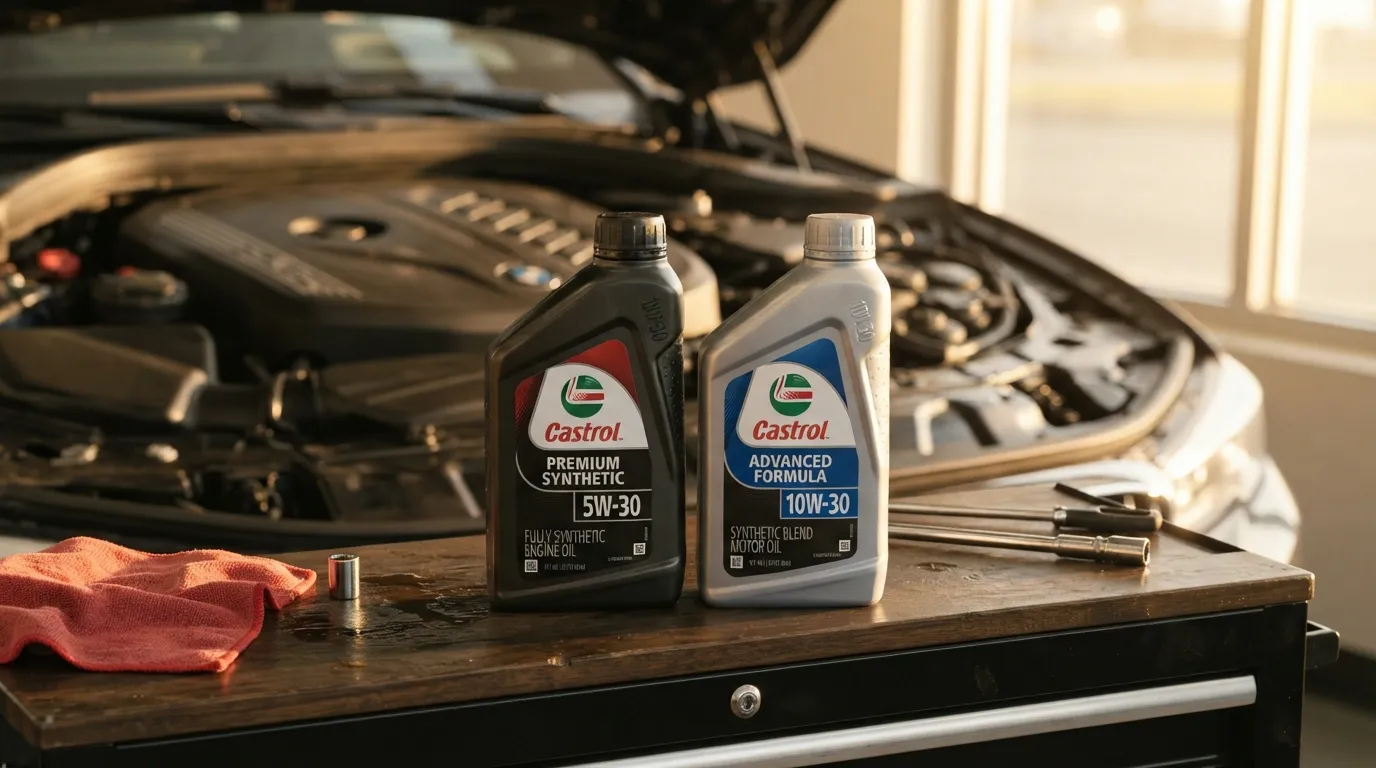
5W30 flows better at cold start; 10W30 is thicker in cold but similar at operating temperature.
I have spent more than a decade working on engines and testing oils. In this guide I compare 5w30 vs 10w30 engine oil with clear, practical advice. You will learn what the numbers mean, when to pick each grade, real-world tradeoffs, and safe switching tips. Expect simple language, hands-on tips, and facts that help you choose the right oil for your car or truck.

What the numbers mean: understanding 5w30 vs 10w30 engine oil
Viscosity grades like 5W-30 and 10W-30 come from the SAE scale. The first number with W shows cold-start viscosity. Lower means thinner at cold start and easier cranking. The second number shows high-temperature viscosity. Both 5W-30 and 10W-30 have similar hot-film thickness at operating temperature. That means protection at running temperature is nearly the same for both grades.

Key technical differences between 5w30 vs 10w30 engine oil
- Cold-flow performance: 5W-30 flows faster in cold weather than 10W-30. This helps quick oil pressure and faster lubrication on startup.
- Startup wear: 5W-30 reduces startup wear in cold climates because it reaches moving parts sooner.
- Operating protection: At engine operating temperatures the “30” rating gives similar viscous film strength for both oils.
- Fuel economy: 5W-30 can give a slight fuel economy edge in stop-start city driving, mainly in cold climates.
- Compatibility: Both grades meet similar API specs often, but check manufacturer recommendations for your engine.

Why engine manufacturers specify one grade over another
Manufacturers test engines with specific viscosity ranges. They set grades to balance oil pressure, clearances, emissions, and fuel economy. Using the recommended grade helps maintain warranty coverage and emission performance. Some newer engines require low-viscosity oils for variable valve timing and turbochargers. Always check the owner’s manual before swapping between 5w30 vs 10w30 engine oil.

When to choose 5w30 vs 10w30: climate and usage guidelines
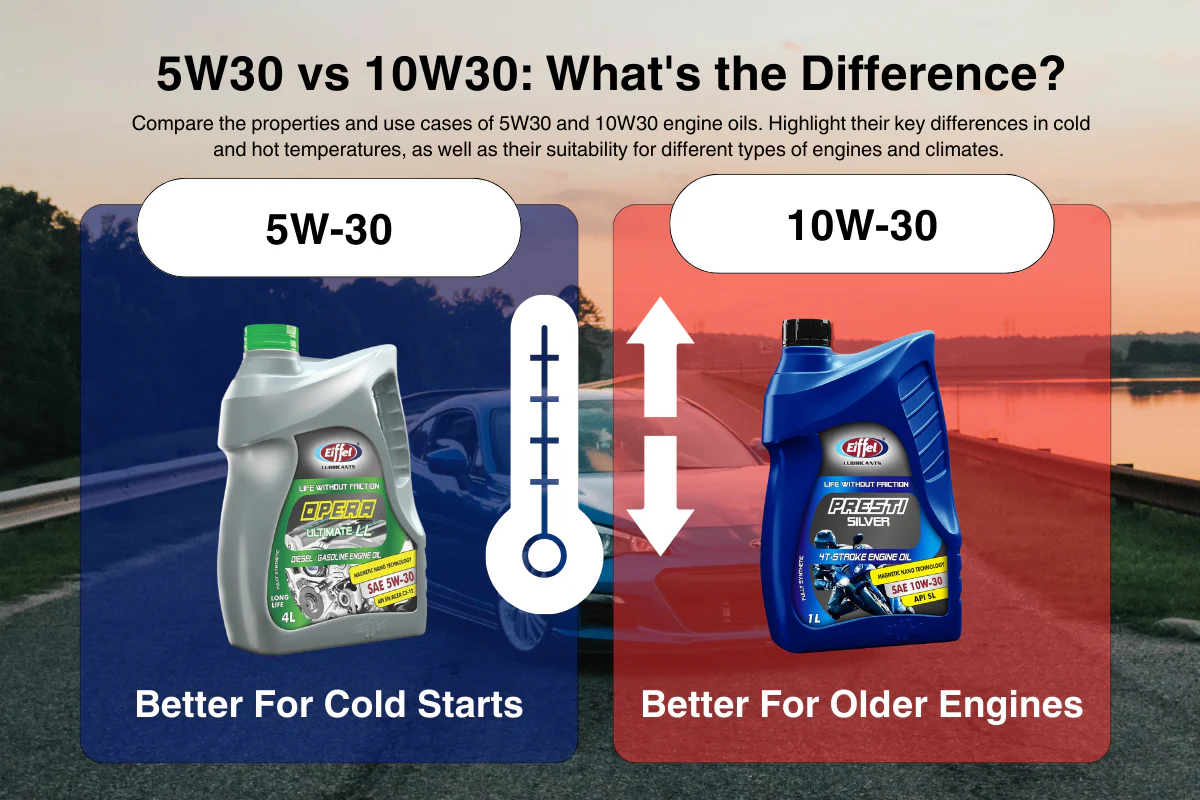
- Cold climates and freezing winters: Choose 5W-30 for faster cold starts and reduced wear.
- Mild to warm climates: 10W-30 is acceptable and can be marginally thicker at cold start without harm.
- High-mileage engines with larger clearances: 10W-30 may help maintain oil pressure and reduce leaks in older engines.
- Turbocharged and high-output engines: Follow the maker’s spec, but modern synthetics of either grade usually work if they meet API/ACEA specs.
- Short trips and stop-start driving: 5W-30 helps because the engine spends more time in the warm-up phase where cold flow matters.

Synthetic vs conventional: impact on 5w30 vs 10w30 engine oil choice
Synthetic oils have better viscosity index and resist thinning at high temperatures. A synthetic 10W-30 will still flow better than a conventional 5W-30 at many temperatures. Many automakers recommend synthetic 5W-30 or synthetic 0W-20 for newer engines. When comparing 5w30 vs 10w30 engine oil, consider whether the oil is full synthetic, synthetic blend, or conventional, because base oil and additive packages change real-world performance.
Performance, wear protection, and fuel economy tradeoffs
Both 5w30 vs 10w30 engine oil protect the engine at operating temperature similarly. The main tradeoff is cold-start protection. Faster flow on startup reduces friction losses and wear. Fuel economy gains from 5W-30 are small but measurable in many tests. Wear protection depends on additive packages and base oil, not just the SAE number. Choose oils that meet the OEM specs and have proven additive chemistry for anti-wear and detergent performance.

How to switch between 5w30 vs 10w30 engine oil safely
- Check the owner’s manual for allowed grades and temperature ranges.
- If switching for the season, change oil when the engine is warm to help flush contaminants.
- If switching due to mileage or leaks, consider a gradual change and monitor oil pressure and consumption.
- After switching, check for leaks and measure oil level after several heat cycles.
- If you use oil additives, verify compatibility with the new oil type.

My hands-on experience with 5w30 vs 10w30 engine oil
I once serviced two identical cars for a fleet. One used 5W-30 year-round, the other ran 10W-30 in winter and summer. The 5W-30 car started easier in winter and had slightly lower oil consumption. The 10W-30 car showed marginally higher oil pressure in summer and a tiny drop in fuel efficiency. From that work I learned to follow manufacturer specs first, then choose grade based on climate and engine wear. If in doubt, use the thinner winter-grade for cold starts and the thicker grade for worn engines.
Common myths and mistakes when comparing 5w30 vs 10w30 engine oil
- Myth: A higher “W” number means a stronger oil. The “W” only describes cold viscosity.
- Mistake: Changing grade without checking manufacturer limits can void warranties or harm emission systems.
- Myth: Thicker oil always protects more. At cold start, a thicker oil can increase wear before it flows.
- Mistake: Ignoring oil type. Using conventional oil where synthetic is recommended reduces protection and service life.
Frequently Asked Questions of 5w30 vs 10w30 engine oil
What is the main difference between 5W-30 and 10W-30?
The main difference is cold-start flow. 5W-30 flows easier at low temps, while both have similar viscosity at normal engine temperatures.
Can I switch from 10W-30 to 5W-30?
Yes, you can switch if the manufacturer’s specs allow it. Switching helps cold starts; check oil type and service intervals.
Will 5W-30 improve fuel economy over 10W-30?
5W-30 can provide a small fuel economy gain in cold conditions due to reduced engine drag at startup. The difference is usually modest.
Is 10W-30 better for older engines?
10W-30 can help maintain oil pressure in older engines with larger clearances and may reduce leaks and consumption. Always monitor oil level after switching.
Does synthetic 5W-30 outperform conventional 10W-30?
Often yes. Synthetic 5W-30 usually offers better high-temp stability and cold flow than conventional 10W-30, but compare specs and approvals.
Will changing oil grade affect my warranty?
If you use a grade outside your owner’s manual limits you may risk warranty issues. Stick to the recommended viscosity and approvals to stay safe.
Conclusion
Choosing between 5w30 vs 10w30 engine oil comes down to climate, engine condition, and manufacturer guidance. Use 5W-30 for cold starts and better low-temp protection. Use 10W-30 when a slightly thicker cold oil helps older engines or when the manual allows it. My practical tip: follow the owner’s manual, then pick the grade that matches your climate and how you drive. If you found this useful, try one season with your chosen grade and monitor oil consumption and start behavior, then share your results or ask a question below.