
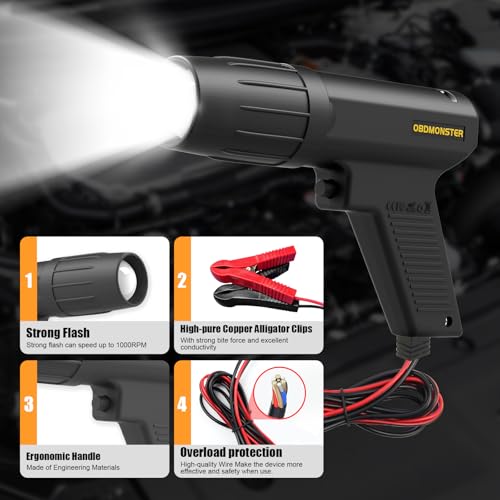
On an engine with a distributor, ignition timing decides when each spark plug fires. If it is too far advanced, the engine can ping under load; if it is too retarded, it feels lazy, runs hot and wastes fuel. A timing light flashes in step with the number one spark plug, so the timing marks on the crank pulley appear to stand still and you can read and set the timing.
This guide explains which engines still need a timing light, what dial-back and digital features do, and compares five lights using the details their makers list. We replaced three lesser-known lights in the earlier version with Innova’s three best-known models.
What you’ll learn
- Which engines a timing light is for
- Inductive pickups and dial-back advance
- Tach, dwell and voltage readouts
- Which of five lights suits you
Quick answer
For most home mechanics with an older or classic engine, the Innova 3568 is the pick: it has a 0–90° dial-back advance and a digital tachometer. Choose the Innova 3551 if you only need to check base timing, and the MSD 8992 for high-RPM performance engines.
Does your engine need a timing light?
Most engines built since the late 1990s have computer-controlled timing with no distributor to turn, and many use coil-on-plug ignition with no plug wire to clamp. On those engines you read timing advance with a scan tool instead. A timing light is for distributor engines, classics, small engines and performance builds.
In this article
How to choose an automotive timing light
Inductive pickup
All the lights here use an inductive pickup that clamps around the number one spark plug wire. You don’t need to disconnect anything, and the clamp reads the spark through the wire’s insulation. Make sure the clamp faces the right way and is closed fully, or the light can skip flashes.
Basic vs dial-back (advance) lights
A basic light only shows where the timing marks line up. A dial-back or advance light lets you delay the flash by a set number of degrees, so you can measure total advance at higher RPM using only the TDC mark. That is useful on engines whose pulley has only one or two marks.
Digital readouts
Digital lights add a tachometer, and some also show dwell and battery voltage. A built-in tach saves you from attaching a separate one when you set idle speed and timing together.
Brightness and build
A bright flash matters in daylight. Look for a shock-resistant housing and long, detachable leads that keep you clear of the fan and belts.
Work safely
Keep the leads, your hands and loose clothing away from the fan and belts. Follow the vehicle’s procedure, which may require disconnecting a vacuum advance hose or jumping a timing connector.
Quick comparison
| Model | Type | Best for | Key features (from the maker’s listing) | Amazon |
|---|---|---|---|---|
| Innova 3568 Digital Timing Light | Dial-back digital | Classic and older engines | Direct-reading 0–90° advance, tachometer 249–9,990 RPM, split-screen LCD, works with most ignition systems | Amazon |
| Innova 5568 Pro Digital Timing Light | Dial-back digital | Enthusiasts who want every readout | Digital advance, tachometer, dwell and voltage; skip circuitry test to 9,990 RPM; detachable 6 ft leads | Amazon |
| Innova 3551 Inductive Timing Light | Basic inductive | Checking base timing | Checks timing, no-spark conditions and advance/retard; works with DIS systems; skip circuitry test | Amazon |
| OBDMONSTER Automotive Timing Light 12V | Basic inductive | Occasional use and small engines | 12 V inductive pistol-grip light for 2- and 4-stroke gasoline engines; color-coded clips | Amazon |
| MSD 8992 Timing Pro Timing Light | Performance | Race and high-RPM engines | No timing retard as RPM rises, secure pickup, detachable leads | Amazon |
The five timing lights compared
How we chose: we compared these timing lights using the details each maker lists on Amazon (checked in November 2026): pickup type, advance range, readouts and build. We have not tested these lights ourselves.
1. Innova 3568 Digital Timing Light

Innova’s 3568 combines a dial-back advance that reads directly from 0 to 90 degrees with a digital tachometer from 249 to 9,990 RPM, shown together on a split-screen LCD.
Innova lists it for conventional, electronic and computer-controlled ignition systems on domestic and import vehicles.
Why it’s a good pick
- Measures total advance
- Built-in tachometer
- Well-known brand
Keep in mind
- Mid-range price
- No dwell or voltage readout
2. Innova 5568 Pro Digital Timing Light

The 5568 is Innova’s top model. It adds dwell and voltage readouts to the advance and tachometer functions, and has a patented skip circuitry test up to 9,990 RPM.
Its heavy-duty housing has a molded boot to protect it from fan blades, and the 6-foot leads are detachable.
Why it’s a good pick
- Four readouts in one tool
- Protective boot
- Long, detachable leads
Keep in mind
- Most expensive Innova here
- Dwell matters only on points ignitions
3. Innova 3551 Inductive Timing Light
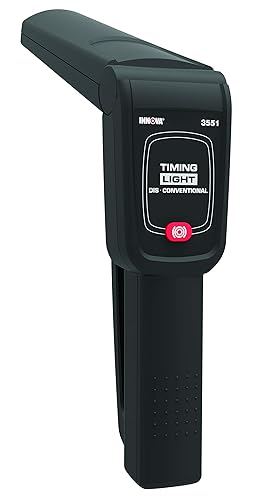
The 3551 is Innova’s simple inductive light. It checks timing, helps diagnose a no-spark condition and shows whether electronic advance or retard is working.
Innova lists it for most ignition systems, including DIS, and its slim, rotating barrel makes it easier to aim at the timing marks.
Why it’s a good pick
- Low price from a known brand
- Also checks for spark
- Easy to aim
Keep in mind
- No dial-back advance
- No tachometer
4. OBDMONSTER Automotive Timing Light 12V

This low-cost inductive light runs from a 12-volt battery and is listed for 2- and 4-stroke gasoline engines, including motorcycles.
It has a pistol-grip body and red and black battery clips. It is the most-reviewed light in this guide.
Why it’s a good pick
- Lowest price
- Covers small engines
- Simple to use
Keep in mind
- Lesser-known brand
- No digital readouts
5. MSD 8992 Timing Pro Timing Light
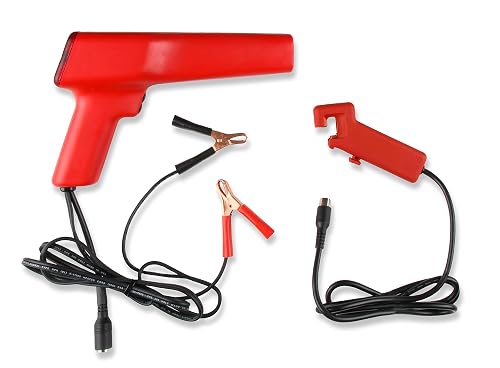
MSD is best known for performance ignition systems. Its Timing Pro light is designed not to retard as RPM increases, which matters when you check total timing on a high-revving engine.
MSD lists a secure inductive pickup and detachable leads.
Why it’s a good pick
- Accurate at high RPM
- Made by an ignition specialist
- Detachable leads
Keep in mind
- Far more expensive than the others
- More than most street engines need
Verdict
The Innova 3568 is the best fit for most people working on distributor engines, because it measures total advance and RPM in one tool. The Innova 5568 adds dwell and voltage if you want every readout.
For a quick base-timing check, the Innova 3551 or the budget OBDMONSTER light is enough. Choose the MSD 8992 only for high-RPM performance engines.
Frequently asked questions
Sources
- Manufacturer product listings on Amazon (features and ranges), checked November 2026
- Ignition timing (Wikipedia)
- Timing light (Wikipedia)