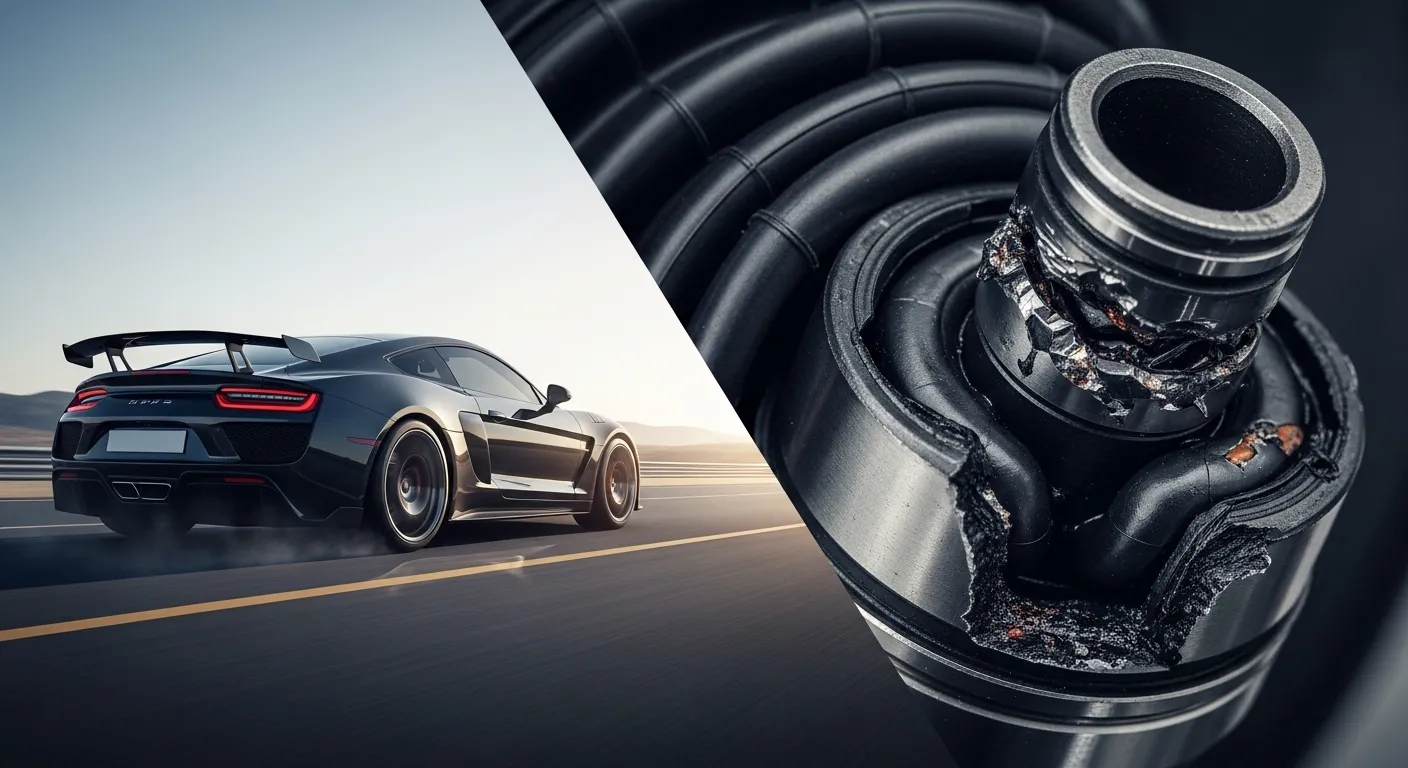
Most often, it signals a worn CV joint or loose suspension parts.
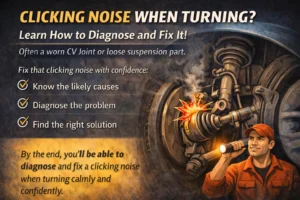
If you hear a clicking noise when turning, do not ignore it. I have fixed this sound on many cars, and the cause is often clear. This guide explains each likely source, how to check it, and what to do next. By the end, you will know how to diagnose and fix a clicking noise when turning with calm and confidence.
What that clicking noise means and why it happens
A clicking noise when turning points to parts that move with the wheels. The most common cause is an outer CV joint. It clicks as the balls and cage wear. The sound is sharp and repeats in a turn.
Other causes can copy that sound. Wheel bearings hum and can click when they are very worn. Loose lug nuts can click as the wheel shifts on studs. A worn ball joint can pop or click as load flips. A bad tie rod end can click as you steer. Sway bar links can tap as the bar twists. A loose brake pad clip can tick with rotor speed. A cracked dust shield can scrape and click.
Where it happens matters. If the clicking noise when turning is louder in a tight, slow turn, think CV joint. If it changes with speed but not with steering, think bearing. If it clicks when you hit bumps, think links or joints. If it clicks after a recent brake job, check pad hardware.
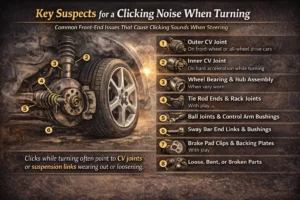
Key suspects for a clicking noise when turning:
- Outer CV joint on front-wheel or all-wheel drive cars
- Inner CV joint on hard acceleration while turning
- Wheel bearing and hub assembly when very worn
- Tie rod ends and rack joints with play
- Ball joints and control arm bushings
- Sway bar end links and bushings
- Brake pad clips, shims, or backing plates
- Backing plates or shields bent into the rotor
- Loose lug nuts or wheels not seated
- Strut mounts with broken bearings
From shop experience, nine out of ten front end clicks in a turn are CV joints or links. Salt, torn boots, and old grease speed up wear. The clicking noise when turning gets worse fast once the grease leaks out.
Quick checks you can do at home
You can find a lot in ten minutes. Use a safe, flat spot. Set the brake. Chock the wheels.
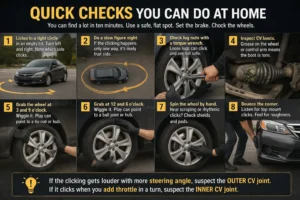
Do this first:
- Listen in a tight circle in an empty lot. Turn left and right. Note which side clicks.
- Do a slow figure eight. If the clicking noise when turning happens only one way, it is likely that side.
- Check lug nuts with a torque wrench. Loose lugs can click and are not safe.
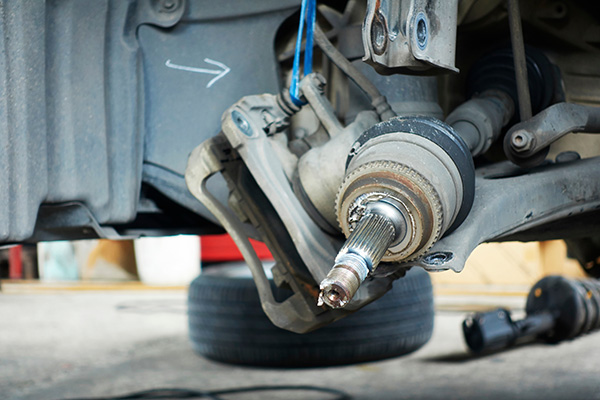
- Look at CV boots. If you see grease on the wheel or control arm, the boot is torn.
- Grab the wheel at 3 and 9 o’clock. Wiggle it. Play can point to a tie rod or hub.
- Grab at 12 and 6 o’clock. Wiggle it. Play can point to a ball joint or hub.
- Spin the wheel by hand. Hear scraping or rhythmic clicks? Check shields and pads.
- Bounce the corner. Listen for top mount clicks. Feel for roughness.
If the clicking noise when turning gets louder with more steering angle, suspect the outer CV joint. If it clicks when you add throttle in a turn, suspect the inner CV joint.
When to stop driving and safety risks
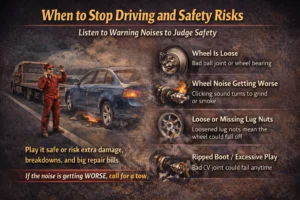
Some clicks mean you can drive to a shop. Some mean you should tow. A CV joint that clicks but has no play can often make it a short time. A joint with heavy play or a ripped boot can fail soon. When it fails, you can lose drive. That can be risky in traffic.
If the wheel is loose, do not drive. A bad wheel bearing or ball joint can let the wheel fold. If lug nuts are loose, stop now. Tighten them in a star pattern. If the clicking noise when turning comes with grind or smoke, park the car and call a tow.
Best rule: if the sound is new, sharp, or getting worse fast, limit use. A safe fix beats a big bill.
Repair options, costs, and time
Costs vary by car and part brand. Here are common fixes for a clicking noise when turning:
- Outer CV axle replacement: 1–2 hours per side. Parts 120–350 USD each. Labor 120–300 USD.
- Wheel hub and bearing: 1–2.5 hours per side. Parts 90–300 USD. Labor 150–350 USD.
- Outer tie rod end: 0.7–1.0 hour. Parts 25–120 USD. Labor 90–150 USD. Needs alignment.
- Ball joint or control arm: 1–3 hours per side. Parts 60–350 USD. Labor 150–450 USD. Often needs alignment.
- Sway bar link: 0.5–1 hour. Parts 20–90 USD. Labor 70–140 USD.
- Brake hardware or shield adjustment: 0.3–0.8 hour. Parts often under 30 USD.
Prices change with AWD, rust, and brand. A full axle often costs less in labor than a joint reboot. If the boot just tore and the joint is clean, a reboot can save cash. Ask for options. A clear line item quote is a good sign.
Source: neighborhoodtirepros.com
How a pro diagnoses the sound
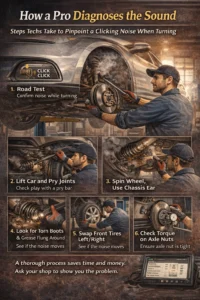
A good tech follows a path. First, confirm the clicking noise when turning on a road test. Then use a lift and a pry bar to check play at joints. Spin wheels and listen with a chassis ear. Look for torn boots and flung grease. Check torque on axle nuts. Check shields for rub marks.
Next, the tech may swap front tires left to right. If the noise moves, it might be a tire issue. Some block tread tires click. A scan of ABS live data can spot a bad bearing sensor pattern. A laser or dial gauge can find rotor runout that hits a bent shield.
This method avoids guesswork. It saves you time and money. Ask your shop to show you the play or the leak. Seeing it builds trust.
Preventive care to avoid the noise
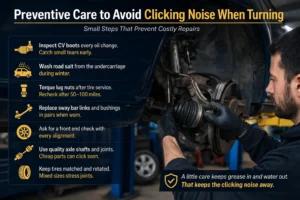
You can prevent many causes of a clicking noise when turning. Small steps help a lot.
Do these on a set schedule:
- Inspect CV boots every oil change. Catch small tears early.
- Wash road salt from the undercarriage in winter.
- Torque lug nuts after tire service. Recheck after 50–100 miles.
- Replace sway bar links and bushings in pairs when worn.
- Ask for a front end check with every alignment.
- Use quality axle shafts and joints. Cheap parts can click soon.
- Keep tires matched and rotated. Mixed tire sizes stress joints.
A little care keeps grease in and water out. That keeps the clicking noise when turning away.
Real stories from the shop: lessons learned
A customer came in with a faint clicking noise when turning left. The outer boot had a pin hole. We caught it early. A reboot and fresh grease fixed it for a quarter of an axle swap.
Another driver heard a click after a brake job. A pad clip was out of place and touched the rotor hat. A small tweak and the sound was gone. No new parts needed.
I once chased a random click for days on my own car. It only clicked in tight right turns. The cause was a loose axle nut that lost torque after a hub swap. One torque to spec, and silence. The lesson: start with basics.
Frequently Asked Questions of clicking noise when turning
Is a clicking noise when turning always a CV joint?
No. It is the most common cause, but not the only one. Bearings, links, and brake hardware can also click.
Can a wheel bearing make a clicking noise when turning?
Yes, but it often hums first. With severe wear, it can click or knock in turns.
Is it safe to drive with a clicking noise when turning?
Short trips might be fine if mild and stable. If the sound grows fast or the wheel has play, tow it.
Why does the noise get louder in tight turns?
The joint angle increases, which loads worn parts. That makes each defect pass louder and more often.
Will an alignment fix a clicking noise when turning?
No. Alignment does not fix worn parts. Replace the bad part first, then align to protect tires.
Can tires cause a clicking noise when turning?
Yes. Stones stuck in tread or certain block patterns can click. Check tires and remove debris.
How do I know which side is bad?
Turn in a circle. If it clicks louder on the right turn, the left outer joint is often the cause.
Does AWD make the clicking worse?
AWD adds load to joints and bearings. Wear can show sooner if boots tear or grease leaks.
Conclusion
A clicking noise when turning is your car asking for help. Most times, the fix is clear and not scary. Start with simple checks, confirm the source, and choose solid parts. Act early, and you save money, time, and stress.
If this guide helped, share it with a friend. Subscribe for more simple car care tips. Drop your questions or your own story in the comments.