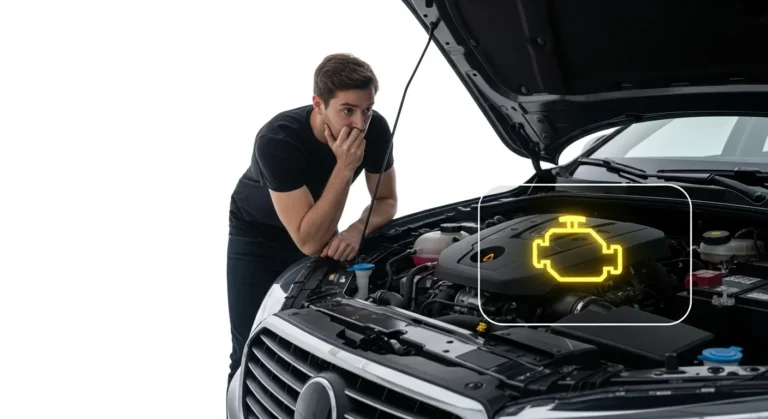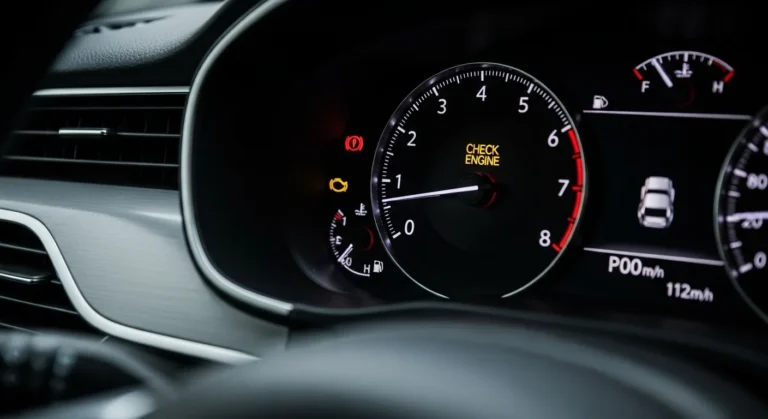
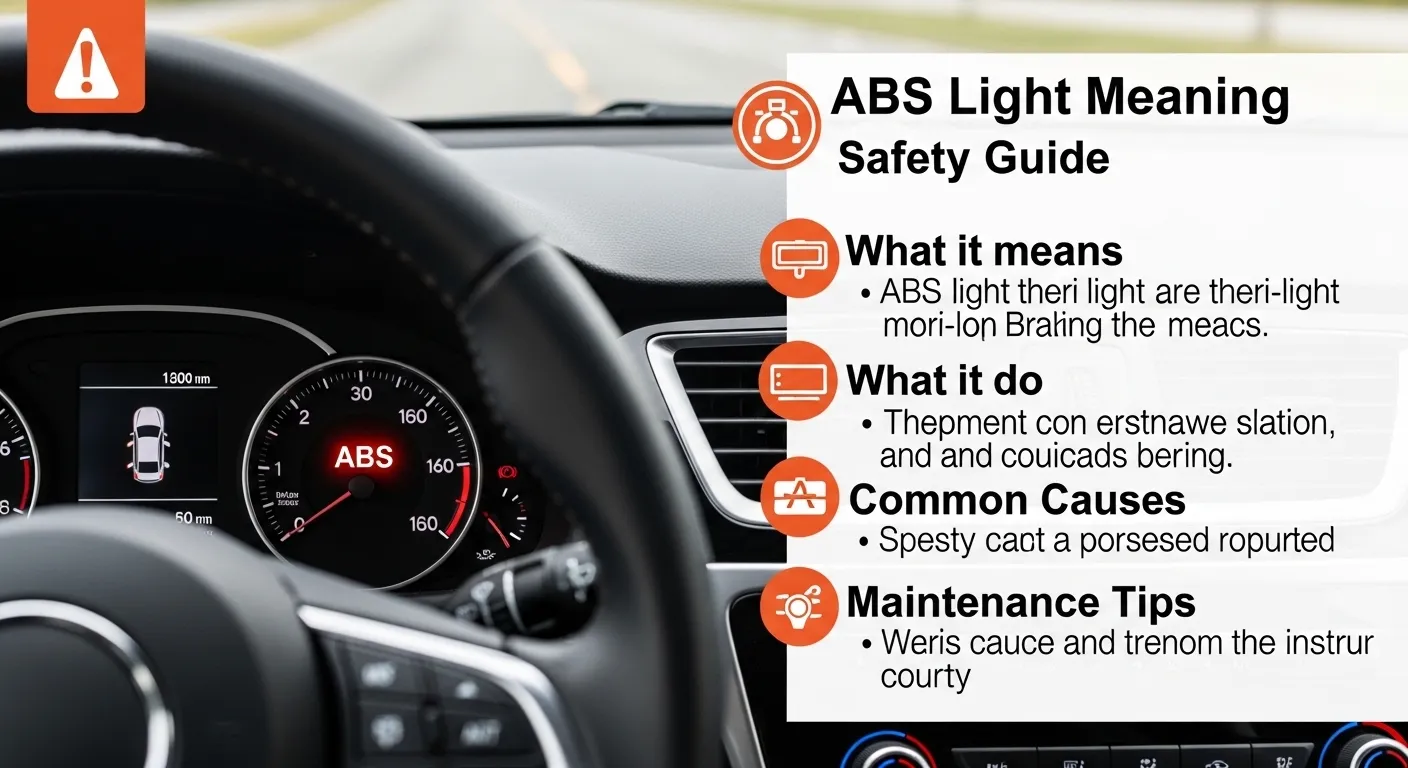
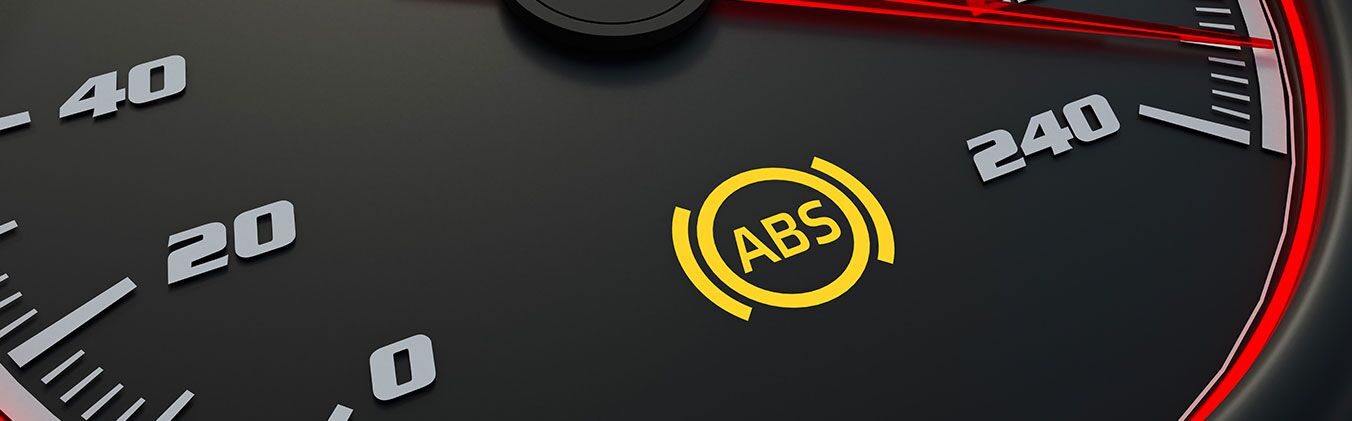
The ABS light means your anti-lock braking system has a fault or is disabled.
If that amber light pops on, do not panic. But do pay attention. In this guide, I explain the abs light meaning in plain language. You will learn what triggers it, how to stay safe, and what to do next. I have helped many drivers and fixed this on my own cars. I will share clear steps, real costs, and pro tips you can use today.
What does the ABS light mean?
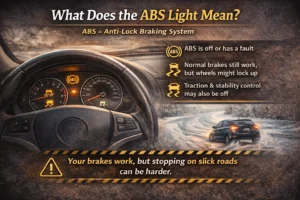
ABS stands for anti-lock braking system. It keeps your wheels from locking up when you brake hard. The ABS light tells you the system found a fault. When it turns on, your normal brakes still work. But ABS help may be off until the fault is fixed.
You might also see traction control or stability control lights. These systems share parts with ABS. A fault in one can disable the others. That is why the abs light meaning often overlaps with traction or stability warnings.
Many cars show a steady ABS light when the system is off. A flashing light can mean an active fault that comes and goes. Check your owner’s manual for how your car behaves. But the bottom line is the same. Your car can stop, yet it may skid more on slick roads.
Does the ABS light mean my brakes failed?
No. Your base brakes still work. You may lose anti-lock help, so the wheels can lock if you brake hard.
Can low brake fluid cause the ABS light?
Yes. Low fluid can trigger the ABS light and the red brake light. Top up with the right fluid and find the leak soon.
Will the ABS light reset itself?
Sometimes. If the cause was low voltage or a loose plug, it can clear after a drive cycle. If not, the fault needs a fix and a scan tool.
Using exact terms helps searchers, so here is a quick recap of the abs light meaning: it warns of an ABS fault, normal braking remains, but anti-lock help may be off. Drive with care and diagnose soon.
Common causes of the ABS light
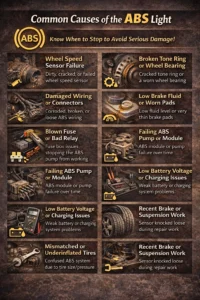
The abs light meaning ties back to one or more parts that feed data to the ABS module. Here are the most common triggers I see in the bay:
- Wheel speed sensor failure The sensor at each wheel reads how fast the wheel spins. Dirt, rust, cracks, or age can kill it.
- Broken tone ring or wheel bearing The tone ring (reluctor) or the bearing’s encoder ring can chip or rust. That scrambles the signal.
- Damaged wiring or connectors Road salt and debris corrode pins and break wires near the wheel hubs.
- Low brake fluid or worn pads The ABS module watches fluid level and pressure. Low fluid can turn the light on.
- Blown fuse or bad relay Power issues stop the ABS pump or valves from working.
- Failing ABS pump or module The hydraulic unit or the control module can fail with age and heat.
- Low battery voltage or charging issues A weak battery or alternator can throw ABS and traction codes.
- Mismatched or underinflated tires Big differences in tire size or pressure confuse the system.
- Recent brake or suspension work If a sensor got bumped or a connector was left loose, the light will come on.
From my experience, wheel speed sensors cause most cases. I have replaced dozens. The fix is often quick and not too pricey. But always test before you replace.
Why does the ABS light come on in cold weather?
Cold can stiffen old wires and crack brittle sensor lines. Ice and slush also pack around hubs and tone rings. That blocks the sensor signal.
Can dirty hubs cause an ABS light?
Yes. Rust flakes or mud at the sensor tip can block readings. A careful clean can restore the signal if the parts are still good.Is it safe to drive with the ABS light on?
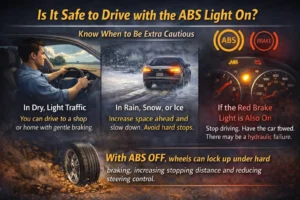
You can drive with care, but your risk is higher in slick or loose conditions. With ABS off, the wheels can lock under hard braking. That can increase stopping distance on wet, snow, or gravel. It also reduces your ability to steer while braking hard.
- In dry, light traffic You can drive to a shop or home with gentle braking.
- In rain, snow, or ice Increase space ahead and slow down. Avoid hard stops.
- If the red brake light is also on Stop driving. Have the car towed. There may be a hydraulic failure.
How far can you drive with the ABS light on?
Only as far as needed to fix it. If roads are slick, avoid driving. If the red brake light is on, do not drive at all.
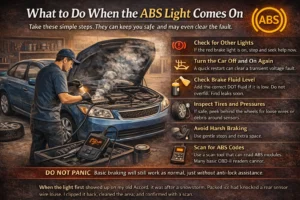
What to do when the ABS light comes on
Take these simple steps. They can keep you safe and may even clear the fault.
- Check for other lights If the red brake light is on, stop and seek help now.
- Turn the car off and on again A quick restart can clear a transient voltage fault.
- Check brake fluid level Add the correct DOT fluid if it is low. Do not overfill. Find leaks soon.
- Inspect tires and pressures Make sure all tires match in size and are at spec PSI.
- Look at the wheel areas If safe, peek behind the wheels for loose wires or debris around sensors.
- Avoid harsh braking Use gentle stops and extra space.
- Scan for ABS codes Use a scan tool that can read ABS modules. Many basic OBD-II readers cannot.
- Note conditions When did the light appear? After hitting a pothole? In heavy rain? This helps diagnosis.
When the light first showed up on my old Accord, it was after a snowstorm. Packed ice had knocked a rear sensor wire loose. I clipped it back, cleaned the area, and confirmed with a scan. The light stayed off after.
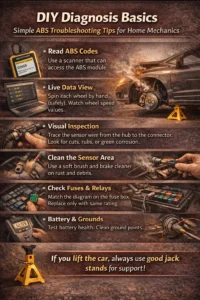
DIY diagnosis basics
If you like to tinker, you can do some safe checks. Keep it simple and use good support stands if you lift the car.
- Read ABS codes Use a scanner that can access the ABS module. Look for wheel speed sensor or pump codes.
- Live data view Spin each wheel by hand (safely). Watch wheel speed values. A dead or jumpy reading points to that wheel.
- Visual inspection Trace the sensor wire from the hub to the connector. Look for cuts, rubs, or green corrosion.
- Clean the sensor area Use a soft brush and brake cleaner on rust and debris. Avoid harsh blasts at seals.
- Check fuses and relays Match the diagram on the fuse box. Replace only with the same rating.
- Battery and grounds Test battery health. Clean ground points. Low voltage can trigger ABS faults.
If you do not have the tools, that is okay. A shop can do these checks fast. Share your notes. It saves time and money.
Common repairs and typical costs
Costs vary by vehicle, region, and brand. These ballpark figures reflect what I see most often in US shops.
- Wheel speed sensor
- Parts: 30 to 200 dollars
- Labor: 60 to 200 dollars
- Hub or bearing with encoder
- Parts: 100 to 400 dollars
- Labor: 150 to 400 dollars
- ABS module or pump
- Parts: 300 to 1,200 dollars
- Labor and programming: 150 to 400 dollars
- Wiring repair
- Parts: 10 to 60 dollars
- Labor: 80 to 200 dollars
- Brake fluid flush
- Parts and labor: 80 to 180 dollars
- Fuse or relay
- Parts: 5 to 30 dollars
- Labor: 0 to 80 dollars
Here is a tip from my bench. Before replacing a sensor, clear codes and wiggle test the harness with live data on. If the speed reading drops when you flex the wire, fix the wire first. I have seen that save customers hundreds.
These estimates show why the abs light meaning matters. A simple sensor fix is common and far cheaper than a module swap. Good testing points to the right repair.

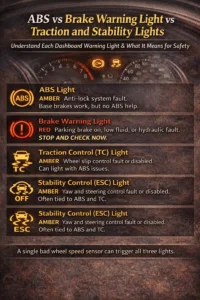
ABS vs brake warning light vs traction and stability lights
It helps to know each icon and what it means for safety.
- ABS light Amber. Anti-lock system fault. Base brakes work, but no ABS help.
- Brake warning light Red. Parking brake on, low fluid, or hydraulic fault. Stop and check now.
- Traction control (TC) light Amber. Wheel slip control fault or disabled. Can light with ABS issues.
- Stability control (ESC) light Amber. Yaw and steering control fault or disabled. Often tied to ABS and TC.
The abs light meaning is specific to anti-lock faults. But many cars link all three systems. A single bad wheel speed sensor can trigger all three lights.
How ABS works in plain language
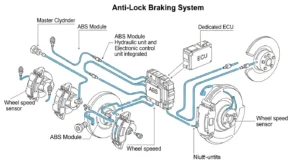
Think of ABS as a rapid brake pulser. It helps you steer while braking hard.
- Sensors at each wheel report speed, many times per second.
- The ABS module looks for a wheel that slows too fast. That means a lock.
- Valves release and reapply brake pressure to that wheel, many times per second.
- You feel a buzzing or pulsation in the pedal. That is normal in an ABS stop.
On wet roads, ABS often shortens stopping distance and helps you keep control. On loose gravel or deep snow, it may not shorten distance by much. But it still helps you steer and avoid a slide. That is why the abs light meaning should not be ignored, especially in bad weather.
Source: earnhardtlexus.com
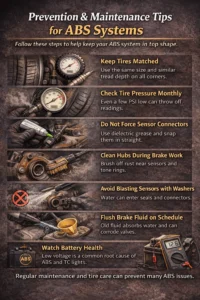
Prevention and maintenance tips
You can prevent many ABS faults with simple care. Here is what I do on my own cars and with customers:
- Keep tires matched Use the same size and similar tread depth on all corners.
- Check tire pressure monthly Even a few PSI low can throw off readings.
- Do not force sensor connectors Use dielectric grease and snap them in straight.
- Clean hubs during brake work Brush off rust near sensors and tone rings.
- Avoid blasting sensors with pressure washers Water can enter seals and connectors.
- Flush brake fluid on schedule Old fluid absorbs water and can corrode valves.
- Watch battery health Low voltage is a common root cause of ABS and TC lights.
Follow these steps and you may never need to ask about abs light meaning again. If it does light up, you will be ready.
Frequently Asked Questions of abs light meaning
What is the abs light meaning in simple terms?
It means your anti-lock braking system has a fault. Normal brakes work, but ABS help may be off.
Can I pass inspection with the ABS light on?
In many states, no. A lit ABS or airbag light often fails inspection until fixed.
Why did my ABS light come on after brake work?
A sensor may have been bumped, left unplugged, or covered in metal dust. Check connections and clean the hub area.
Will disconnecting the battery clear the ABS light?
It might clear memory, but the fault will return if the cause remains. Proper scanning works better.
Is the ABS light related to traction control?
Yes. They share sensors and the control module. A fault in one can light both.
Conclusion
The abs light meaning is clear. Your car found a fault in the anti-lock system, so it shut that help off. Your brakes still work, but hard stops can be longer and less stable, especially on slick roads. Check fluid, tires, and wiring, then scan for codes. Most fixes are simple when you test first.
Take action today. Drive gently, diagnose the cause, and plan the right repair. Want more clear car tips? Subscribe for fresh guides, or leave a question and I will help you troubleshoot your exact symptoms.