
There are two ways to test a car battery. A true load tester draws a heavy current (100 amps or more) for a few seconds and watches the voltage, which is how batteries have been tested for decades. A conductance tester (often still called a load tester) sends a small signal through the battery and estimates its cold cranking amps and health in seconds, without the heat or sparks.
This guide explains the difference and when each makes sense, and compares five testers using the specifications their makers list.
What you’ll learn
- True load testing vs conductance testing
- Why charge level matters
- Testing the starter and alternator too
- Which of five testers suits you
Quick answer
For a traditional load test at home, the Schumacher BT-100 applies a 100-amp load to 12 V batteries and also checks the charging system and starter. If you’d rather not apply a heavy load, a conductance analyzer such as the TOPDON BT300P (with printed reports) or the FOXWELL BT301 (AGM flat and spiral settings) gives CCA and health readings in seconds. For workshops, the Clore Solar 1874 is a 500-amp variable carbon pile tester.
Work safely
Load testers get hot and can spark at the clamps. Test in a ventilated area away from flames, wear eye protection, and don’t load-test a battery that is frozen, swollen or leaking.
In this article
How to choose a battery load tester
True load or conductance
True load testers show how the battery behaves under real current, which many mechanics trust. Conductance testers are faster, safer and give more detail (CCA, state of health, internal resistance), and they work on partly discharged batteries.
Charge the battery first
A true load test needs a battery that is at least about 75% charged; a flat battery will fail even if it’s healthy. Conductance testers can test at lower charge but are still more reliable on a charged battery.
Battery types
If you have AGM or start-stop batteries, choose a conductance tester with AGM settings. Some testers also cover 24 V systems or lithium starter batteries.
Starting and charging tests
Most testers also measure cranking voltage and alternator output, which helps you avoid replacing a good battery when the real fault is elsewhere.
Capacity
Simple 100 A load testers suit cars and light trucks. Variable carbon pile testers (500 A or more) can load a battery to half its CCA rating, the traditional workshop method.
Quick comparison
| Model | Type | Best for | Key features (from the maker’s listing) | Amazon |
|---|---|---|---|---|
| Schumacher BT-100 Battery Load Tester | True load (100 A) | Traditional DIY load testing | 6 V and 12 V batteries up to 1,000 CA; 100 A load test at 12 V (50 A at 6 V); tests battery, charging system and starter draw; for gas and diesel vehicles | Amazon |
| TOPDON BT300P Battery Tester | Conductance | Keeping a record of results | 12 V lead-acid, 100–2000 CCA; conductance testing; built-in printer for receipts; 2.4 in color screen; spark-free copper clamps; reverse-polarity protection | Amazon |
| FOXWELL BT301 Battery Tester | Conductance | Modern cars with AGM or EFB | 12 V 100–2000 CCA; flooded, AGM flat, AGM spiral and more; SOH, SOC, CCA, voltage and internal resistance; cranking and charging tests; 6.5 ft cable; 2.8 in color screen | Amazon |
| ANCEL BT410 Battery Tester | Conductance | Trucks and lithium batteries | 12 V and 24 V; lead-acid and lithium batteries; 100–2000 CCA; battery health, cranking and charging tests; QR reports; protection against reverse connection | Amazon |
| Clore Automotive Solar 1874 Carbon Pile Load Tester | Variable carbon pile | Workshops and serious DIYers | Variable load up to 500 A; tests batteries up to 1000 CCA; starter and alternator assessment | Amazon |
The five battery testers compared
How we chose: we compared these testers using the specifications each maker lists on Amazon (checked in November 2026): test type, load or CCA range, battery types, extra tests and display. An earlier version of this guide included a load tester that was only available from other sellers when we checked, so we replaced it with in-stock options. We have not tested these tools ourselves.
1. Schumacher BT-100 Battery Load Tester

The BT-100 is a classic analog load tester. It applies a 100-amp load to 12 V batteries (50 amps for 6 V) and shows how well the battery holds its voltage.
Schumacher lists three tests in one device (battery health, charging system and starter draw) and compatibility with batteries up to 1,000 cranking amps on gas and diesel vehicles.
Why it’s a good pick
- Real load test
- Also checks alternator and starter
- Simple analog meter
Keep in mind
- Battery must be charged first
- Gets hot; follow the time limits
2. TOPDON BT300P Battery Tester

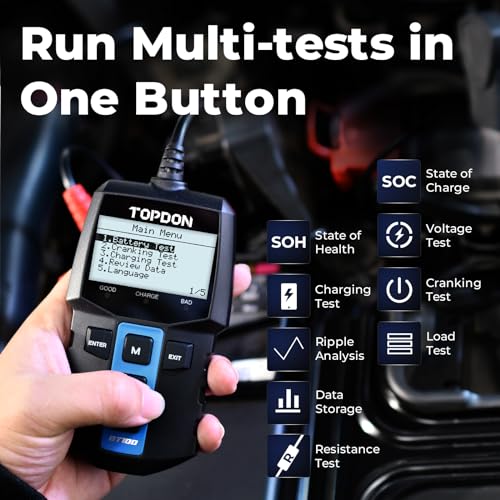
TOPDON’s BT300P uses conductance testing for 12 V batteries from 100 to 2000 CCA and prints a receipt with the results, useful if you sell cars or want a record.
It has a 2.4-inch color screen, spark-free copper clamps and built-in protection against reverse polarity.
Why it’s a good pick
- Printed results
- Spark-free clamps
- Clear color screen
Keep in mind
- Doesn’t apply a real load
- Check the battery-type settings for AGM
3. FOXWELL BT301 Battery Tester

FOXWELL’s BT301 lists settings for flooded, AGM flat and AGM spiral batteries and reports state of health, state of charge, CCA, voltage and internal resistance.
A 6.5 ft cable lets you leave the clamps under the hood and watch the screen from the driver’s seat during the cranking test.
Why it’s a good pick
- AGM settings
- Detailed readings
- Long cable
Keep in mind
- 12 V only
- No real load applied
4. ANCEL BT410 Battery Tester

The BT410 covers 12 V and 24 V systems and both lead-acid and lithium batteries, so it suits mixed fleets of cars and trucks.
It runs battery health, cranking and charging tests and can share results by QR code.
Why it’s a good pick
- 12 and 24 V
- Lithium support
- QR reports
Keep in mind
- Conductance only
- More features than most car owners need
5. Clore Automotive Solar 1874 Carbon Pile Load Tester

A variable carbon pile tester that can apply up to 500 amps, enough to load a battery to half its CCA rating, the traditional workshop method, for batteries up to 1000 CCA.
It also assesses the starter and alternator.
Why it’s a good pick
- Adjustable heavy load
- Traditional workshop method
- Starter and alternator checks
Keep in mind
- Higher price
- More than most home users need
Verdict
For a simple, traditional load test at home, the Schumacher BT-100 is the best value. If you prefer quick, detailed results without a heavy load, choose the FOXWELL BT301 for AGM batteries, the TOPDON BT300P for printed reports, or the ANCEL BT410 for 24 V and lithium. Workshops should look at the Clore Solar 1874.
For AGM-focused testers, see our battery testers for AGM batteries. Battery keeps dying? Read why a car battery keeps dying.
Frequently asked questions
Sources
- Manufacturer product listings on Amazon (specifications), checked November 2026
- Automotive battery (Wikipedia)