Uneven tire wear comes from bad alignment, wrong pressure, worn parts, or habits.
If you want safe, quiet, and long‑lasting tires, you need to understand uneven tire wear causes. I’ve spent years inspecting tread, fixing alignments, and helping drivers stop odd wear. This guide breaks down what the patterns mean, what to check first, and how to fix the root cause with simple steps and pro tips. Read on to save money, cut noise, and keep control at any speed.
What uneven tire wear means and why it matters
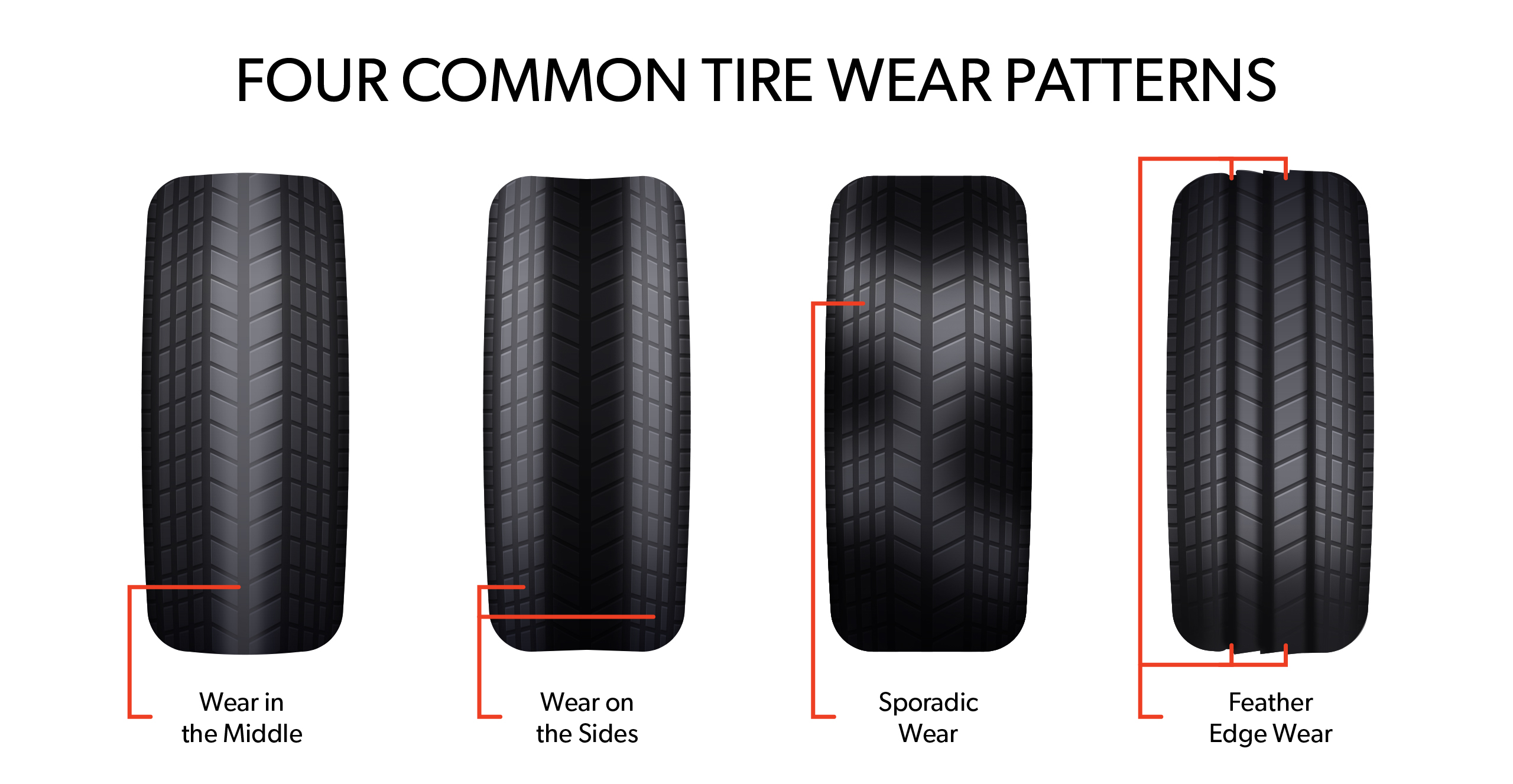
Uneven tire wear is tread that wears faster on some parts of the tire than others. It can show as inner edge wear, outer edge wear, cupping, feathering, or center wear. Each pattern points to a cause.
Why it matters:
- Stopping distance grows because grip drops.
- The car can pull or wander.
- Tires get loud and ride gets harsh.
- Fuel economy suffers and costs rise.
From my shop days, I learned this fast. Most cars came in for noise. The root issue was simple: bad pressure or alignment. Fix the cause early, and you protect your tires and your wallet. Many uneven tire wear causes are quick wins.
Source: telletire.com
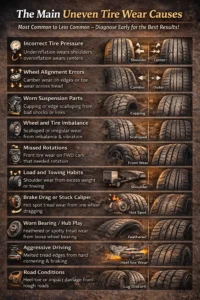
The main uneven tire wear causes
These are the top uneven tire wear causes I see, from most common to less common. Fixing these early gives the fastest payoff.
- Incorrect tire pressure Underinflation wears both shoulders. Overinflation wears the center. Even a 3–5 psi mistake adds up. Check when tires are cold and use the doorjamb spec.
- Wheel alignment errors Camber, toe, and caster drift with potholes and curb hits. Toe error chews tread fast. Negative camber burns inner edges, and positive camber burns outer edges.
- Worn suspension parts Shocks and struts that are weak cause cupping. Loose ball joints, tie rods, and control arm bushings change toe and camber under load. That eats tread.
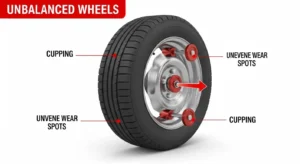
- Wheel and tire imbalance Imbalance causes vibration and scalloped edges at highway speed. A bent wheel or out‑of‑round tire can mimic the same pattern.
- Missed rotations Front tires scrub more on FWD cars. Without rotation, fronts die early. Even wear needs regular, even swaps.
- Load and towing habits Extra weight or tongue weight adds camber and toe change. Shoulders get hot. Tread breaks down faster.
- Brake drag or stuck caliper One wheel gets hot, rubber hardens, and the pattern skews on that corner. A hot wheel after a short drive is a clue.
- Wheel bearing play or hub issues Play changes toe while rolling. It also causes noise and heat. The result is spotty or feathered wear.
- Aggressive driving Hard cornering, late braking, and sharp steering heat the edges. Add toe error and the edges melt away.
- Road conditions Potholes, speed bumps, and washboard roads beat shocks and shift alignment. Gravel can start heel‑toe wear.
- Tire mix and match Different brands or sizes on the same axle fight each other. Tread patterns shear and wear oddly.
- Wrong lug torque or dirty hubs Uneven clamping distorts the wheel. It makes slight runout and patterns that look like balance issues.
These uneven tire wear causes often stack. A little low pressure plus a little toe error can look like a big problem. Solve both for a clean fix.
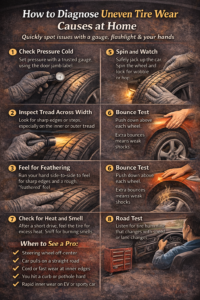
How to diagnose uneven tire wear causes at home
You can spot most issues in 10 minutes. Use a good gauge, a flashlight, and your hands.
Step-by-step:
- Check pressure cold Use a trusted gauge. Set to the doorjamb label, not the sidewall.
- Inspect tread across the width Feel for sharp edges, steps, or waves. Look at inner edges with the wheel turned full lock.
- Measure tread depth Use a simple gauge or a coin. Compare inner, center, and outer on each tire.
- Feel for feathering Run your hand across the tread. If it feels smooth one way and rough the other, toe is off.
- Spin and watch Jack safely. Spin the wheel. Look for wobble or hop. That hints at bent rims or out‑of‑round tires.
- Bounce test Push down above each wheel and release. One smooth rise is good. Extra bounces point to weak shocks or struts.
- Check for heat and smell After a short drive, feel near each wheel (not the rotor). One very hot corner can mean brake drag.
- Road test Listen for humming that changes with speed or lane changes. Vibration at certain speeds can be balance or cupping.
When to see a pro:
- Steering wheel is off‑center.
- Car pulls on a straight road.
- You see inner edge cords or fast wear.
- You hit a curb or pothole hard.
- Your EV or performance car shows rapid inner wear.
These signs point to alignment and suspension checks on a rack. That is the only way to set toe, camber, and caster with accuracy. A quick check can save a set of tires.
Wear pattern guide and what they mean
Patterns are clues. Read them like a map, and you land on the fix fast.
Inner edge wear
- Likely causes Excess negative camber, toe‑out, or sagging springs. Common on lowered cars and many EVs due to weight.
- Fix actions Set alignment to factory or a tire‑friendly spec. Check bushings and ride height. Rotate sooner.
Outer edge wear
- Likely causes Excess positive camber, underinflation, or hard cornering on FWD cars.
- Fix actions Correct pressure. Set camber and toe. Smooth your steering inputs.
Center wear
- Likely causes Overinflation or too narrow a wheel for the tire size.
- Fix actions Set pressure to the doorjamb. Use the right wheel width for the tire.
Cupping or scalloping
- Likely causes Weak shocks or struts, imbalance, bent wheel, or cheap, hard compound tires on rough roads.
- Fix actions Replace worn dampers. Balance wheels. Check for bent rims and wheel bearings.
Feathering or heel‑toe blocks
- Likely causes Toe error, worn bushings, or ride height changes that shift toe as you drive.
- Fix actions Set toe to spec. Repair worn arms and bushings. Recheck after repairs.
One tire wearing fast
- Likely causes Stuck brake caliper, bad wheel bearing, cross‑camber or cross‑caster mismatch.
- Fix actions Free or replace the caliper. Replace the bearing. Align with road‑crown aware settings if needed.
Each pattern ties back to one or more uneven tire wear causes. Fix the root, then rotate to even out the rest of the tread life.
Fixes and prevention plan
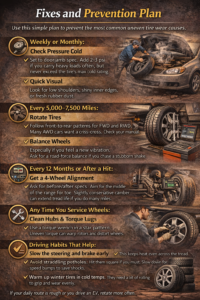
Use this simple plan to prevent the most common uneven tire wear causes.
Weekly or monthly:
- Check pressure cold Set to doorjamb spec. Add 2–3 psi if you carry heavy loads often, but never exceed the tire’s max cold rating.
- Quick visual Look for low shoulders, shiny inner edges, or fresh rubber dust.
Every 5,000–7,500 miles:
- Rotate tires Follow front‑to‑rear patterns for FWD and RWD. Many AWD cars want a criss‑cross. Check your manual.
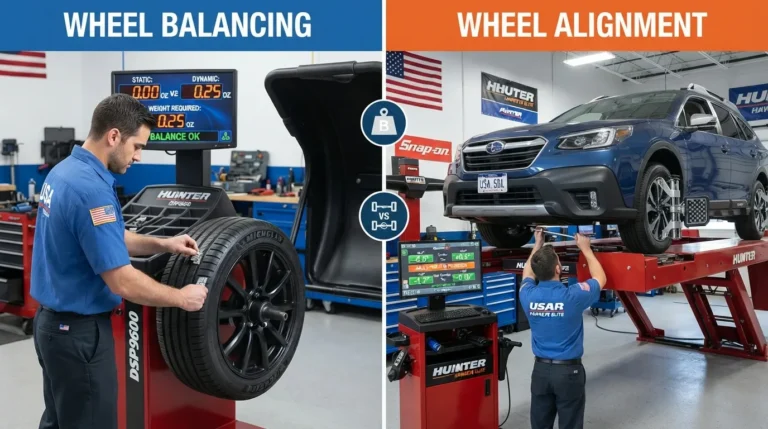
- Balance wheels Especially if you feel a new vibration. Ask for a road‑force balance if you chase a stubborn shake.
Every 12 months or after a hit:
- Get a 4‑wheel alignment Ask for before/after specs. Aim for the middle of the range for toe. Slightly conservative camber can extend tread life if you do many miles.
- Inspect suspension Check shocks, struts, bushings, ball joints, tie rods, and bearings. Fix play before aligning.
Any time you service wheels:
- Clean hubs and torque lugs Use a torque wrench in a star pattern. Uneven torque can warp rotors and distort wheels.
- Verify tire match Keep same size, type, and load index on each axle. AWD systems need close tread depth match.
Driving habits that help:
- Slow the steering and brake early This keeps heat even across the tread.
- Avoid straddling potholes Hit them square if you must. Slow down for speed bumps to save shocks.
- Warm up winter tires in cold temps They need a bit of rolling to grip and wear evenly.
If your daily route is rough or you drive an EV, rotate more often. Small changes like these stop most uneven tire wear causes before they start.
Special cases: EVs, AWD, SUVs, performance cars, and seasons
Different vehicles and seasons change how tires wear. Plan around them to beat uneven tire wear causes.
EVs and hybrids:
- Heavier curb weight and instant torque load inner shoulders.
- Tip Shorter rotations at 3,000–5,000 miles. Ask for a touch less negative camber if within spec. Choose tires with a higher load index.
AWD and 4×4:
- All four tires must match closely to protect the drivetrain.
- Tip Keep tread depths within a small range. Rotate often. Replace in sets if wear is uneven.
SUVs and trucks:
- Extra weight and towing shift camber and toe.
- Tip Use proper load‑range tires. Set pressure for load. Check rear alignment if you tow often.
Performance and lowered cars:
- Aggressive camber and toe sharpen turn‑in but eat tread.
- Tip Ask for a street‑friendly alignment. Slightly reduce negative camber and set minimal toe‑in for highway stability and longer life.
Seasonal swings:
- Cold air drops pressure. Hot days raise it.
- Tip Check pressure with big weather changes. Use winter tires in cold months to cut slip and scrub.
These tweaks address vehicle‑specific uneven tire wear causes. They also boost safety and comfort.

Costs, value, and when to replace
Catching uneven tire wear causes early saves real money. Here is what to expect.
Typical costs:
- Tire rotation Low or included with service.
- Balance Modest per wheel.
- Four‑wheel alignment Mid‑range, worth it after any big hit or part replacement.
- Shocks and struts Parts and labor vary by car. They often pay for themselves in tire life, control, and comfort.
Value math:
- A full set of tires is a major expense. If a simple alignment and rotation add even 10,000 miles of life, you win.
- Proper pressure boosts fuel economy and cuts heat. That slows wear.
When to replace:
- Tread at 4/32 inch Plan the change. Wet grip drops fast here.
- Tread at 2/32 inch It is time. The tire is legally worn out in most places.
- Cords showing on the inner edge Replace now. Also fix the cause before mounting new tires.
Fixing uneven tire wear causes is not just about tires. It is about stable handling and a car that feels right.
Frequently Asked Questions of uneven tire wear causes
What is the fastest way to stop uneven tire wear?
Set pressure to the doorjamb label and rotate now. Then schedule an alignment to correct toe and camber and inspect suspension parts.
How often should I get an alignment?
At least once a year or after any big pothole or curb hit. Also check alignment with every new set of tires or if the wheel is off‑center.
Can bad shocks cause uneven tire wear?
Yes. Weak shocks let the tire bounce, which causes cupping and scalloping. Replace them and balance the wheels to smooth the pattern.
Why are my front tires wearing on the inside?
That is often negative camber and toe‑out on FWD cars. Check alignment, bushings, and ride height, and rotate to even the set.
Do EVs have more uneven tire wear?
They can due to weight and torque. Shorter rotation cycles and careful alignment help a lot.
Is overinflation or underinflation worse?
Both are bad. Underinflation kills the shoulders and adds heat, while overinflation wears the center and can reduce grip.
Can driving style cause uneven wear?
Yes. Hard cornering and late braking scrub the edges. Smooth inputs and steady speeds spread wear more evenly.
Will new tires fix uneven wear by themselves?
No. New tires hide the symptom for a while. You must correct the uneven tire wear causes or the pattern returns.
Conclusion
Uneven tire wear is a message from your car. Read the pattern, match it to the cause, and act early. Set the right pressure, rotate on time, and keep alignment and suspension in shape. Small steps prevent big bills and make every drive safer and smoother.
Take ten minutes today to check your tires. If you spot a pattern, book an alignment and a suspension check. Want more guides like this? Subscribe, share your question in the comments, or ask about your specific wear pattern and I will help you map it to the fix.