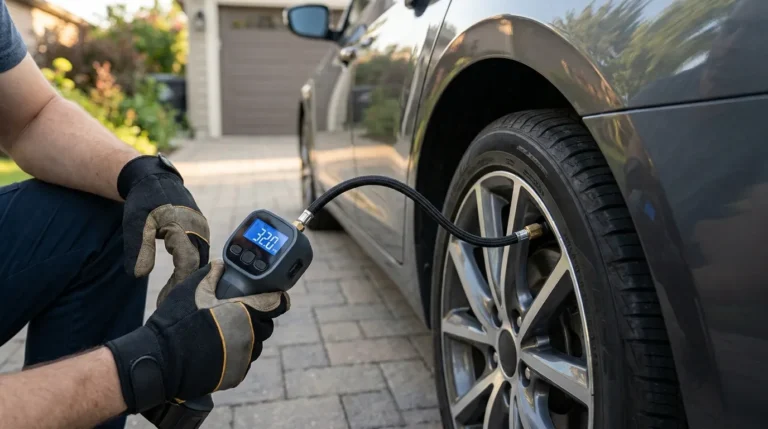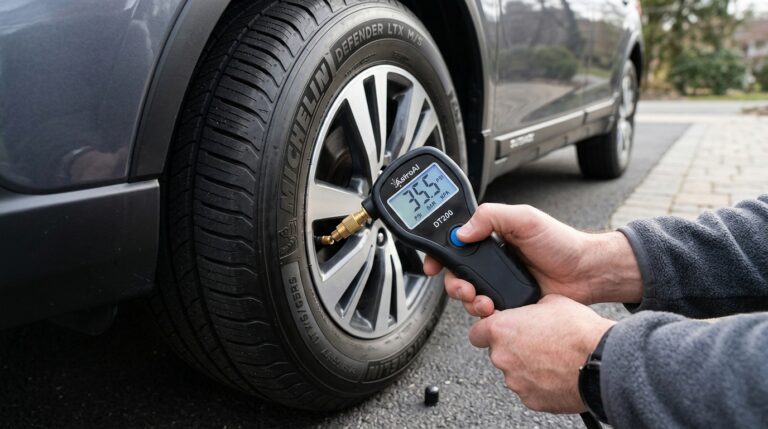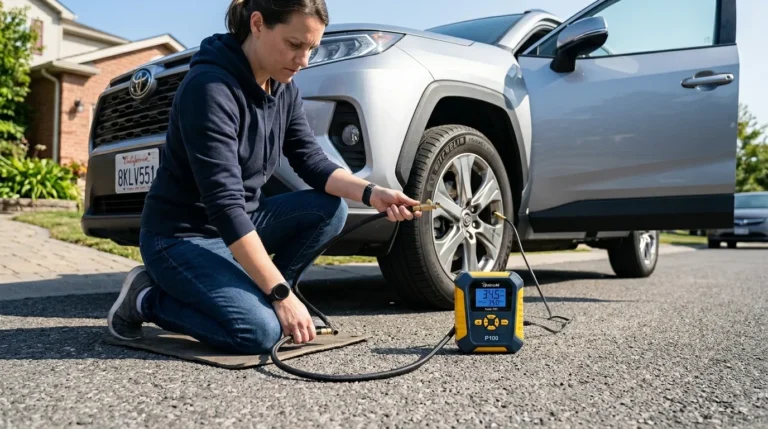
A tire pressure gauge is a handheld tool that reads the air pressure in tires.
If you’ve ever wondered what is tire pressure gauge and why it matters, you’re in the right place. I’ve used and tested every style, from old-school stick gauges to pro-shop digital units. In this guide, I’ll break down what is tire pressure gauge, how it works, and how to use it like a pro. You’ll get clear steps, real-world tips, and expert advice to keep your tires safe, efficient, and long-lasting.
What a Tire Pressure Gauge Does and Why It Matters
A tire pressure gauge measures the force of air inside your tire. Most drivers read it in PSI, but kPa and bar are also common. With a good gauge, you can set the exact pressure your tire needs.
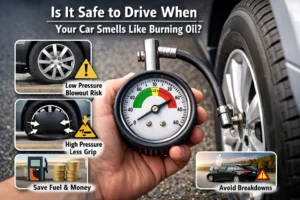
The right pressure is not a guess. It ties to safety, fuel use, and tread life. Low pressure builds heat and can cause a blowout. High pressure makes the tire stiff, which hurts grip and comfort. A small weekly check can save a long roadside wait.
If you ask what is tire pressure gauge in simple terms, it is your first line of defense against avoidable tire trouble. It gives you a fast, true reading before you drive. That one habit can cut risk and cost over time.
How a Tire Pressure Gauge Works
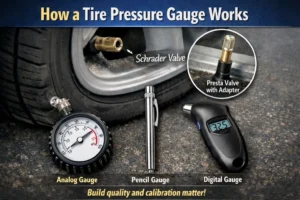
Most gauges connect to a Schrader valve, which is the common valve on cars and trucks. Some bikes use a Presta valve, which needs an adapter on most car gauges. When you press the gauge onto the valve, air pushes on a sensor inside the tool.
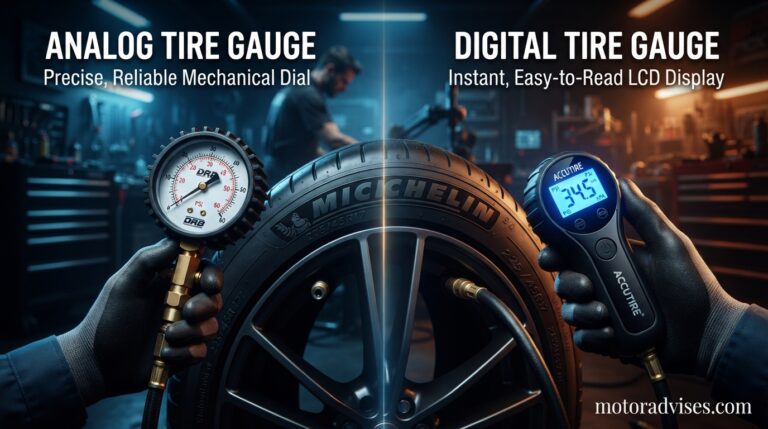
Analog gauges use a small spring tube or piston to move a needle. Digital gauges use an electronic sensor and show the number on a screen. Both can be accurate. The key is build quality and calibration.
From my shop days, I learned this: a cheap gauge that leaks gives bad data. I once chased a “slow leak” for a customer for weeks. The tire was fine; the $3 stick gauge was not. After switching to a calibrated digital model, the readings were stable and true.
Types of Tire Pressure Gauges
Different drivers need different tools. Here are the main types and what to expect.
- Pencil or stick gauge. Small and cheap. It can be hard to read and less consistent.
- Dial analog gauge. A round face with a needle. Often more precise. Look for a bleed valve to fine-tune PSI.
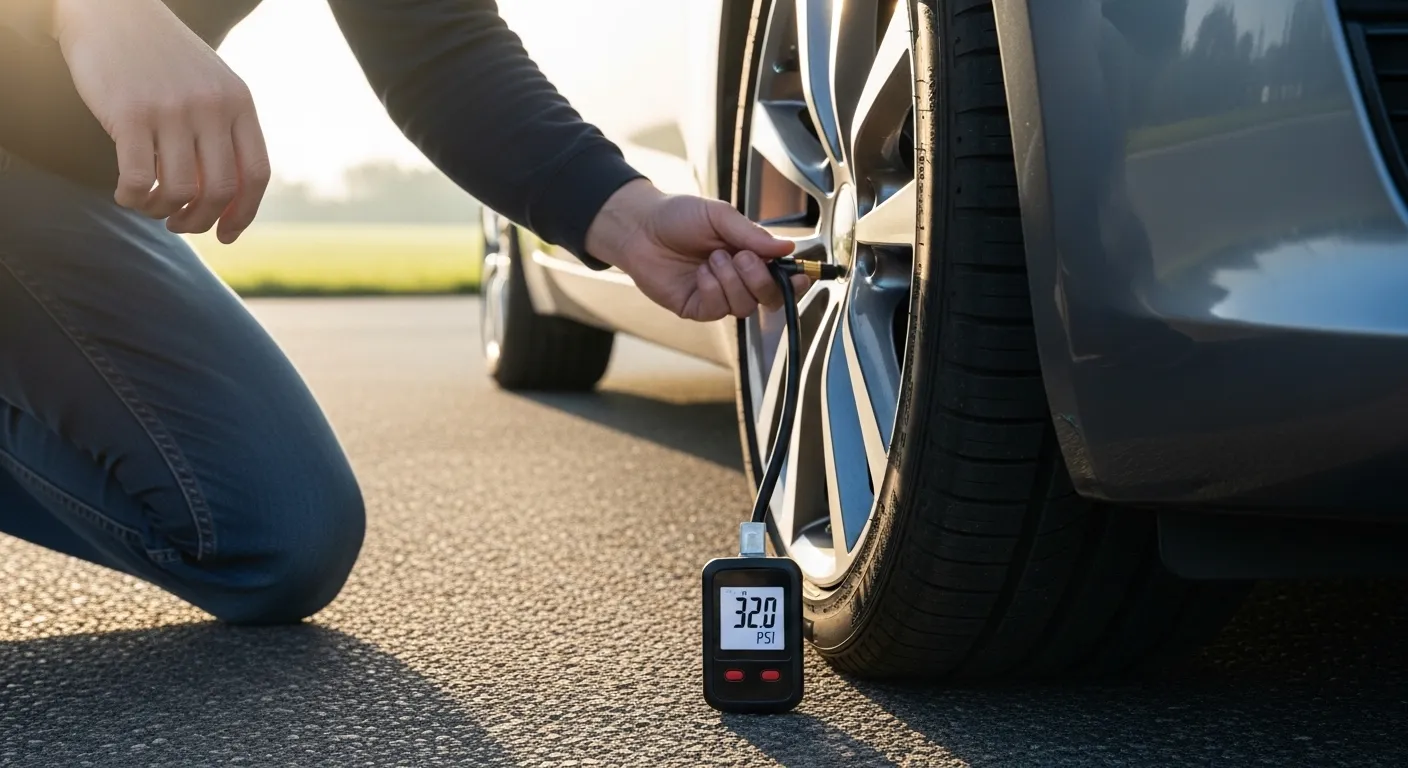
- Digital handheld gauge. Easy to read, even at night. Needs batteries. Good accuracy in a compact body.
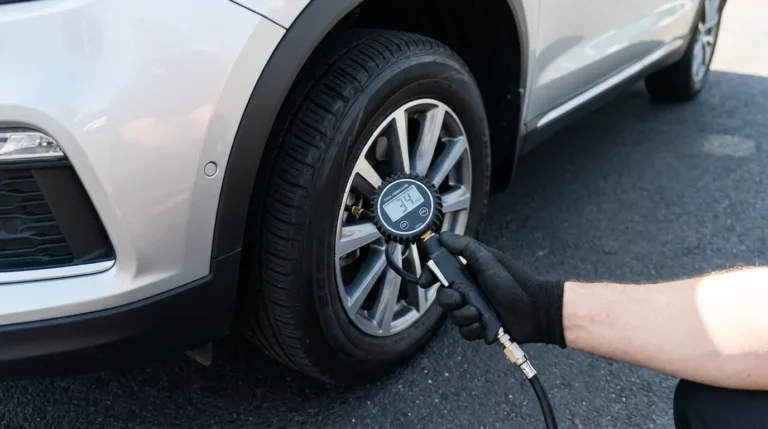
- Inflator gauge with hose. Combines a gauge with an air chuck and trigger. Great in a garage with a compressor.
- Heavy-duty or high-range gauge. For trucks, RVs, or bikes at very high PSI. Make sure the range fits your needs.
For most cars, a 0–60 PSI gauge is perfect. If you ride bikes or drive an RV, match the range to your highest tire spec. When people ask what is tire pressure gauge best for daily use, I often suggest a mid-range digital or a dial with a bleed valve and a flexible hose.

How to Use a Tire Pressure Gauge: Step-by-Step
Use this short process for a fast, accurate reading.
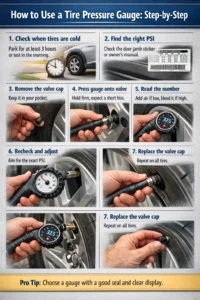
- Check when tires are cold. Park for at least three hours or test in the morning.
- Find the right PSI. Check the driver’s door jamb sticker or the owner’s manual.
- Remove the valve cap. Keep it in your pocket so you don’t lose it.
- Press the gauge straight onto the valve. A short hiss is normal. Hold firm.
- Read the number. If it is low, add air. If it is high, use the bleed valve to drop pressure.
- Recheck after each change. Aim for the exact spec, not “close enough.”
- Replace the valve cap. Repeat on all tires, including the spare.
Here’s a tip I teach new drivers: if you wonder what is tire pressure gauge best for accuracy, pick one with a good seal on the chuck and a clear display. That alone avoids most user errors.
Units, Recommended PSI, and TPMS vs. a Gauge
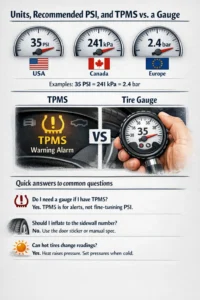
You will see PSI in the US, kPa in Canada, and bar in parts of Europe. For example, 35 PSI is about 2.4 bar or 241 kPa. Your car’s sticker lists the correct cold tire pressure, not the sidewall max.
Many cars have TPMS. It warns you if a tire is far off spec. But it is not a precise setting tool. It can lag. It can read a little high or low. A handheld gauge gives you the exact number, fast.
If a friend asks what is tire pressure gauge and why use it when TPMS exists, I say this: TPMS is an alarm; a gauge is a ruler. You need both, but only one sets exact pressure.
Quick answers to common questions
- Do I need a gauge if I have TPMS? Yes. TPMS is for alerts, not fine-tuning PSI.
- Should I inflate to the sidewall number? No. Use the door sticker or manual spec.
- Can hot tires change readings? Yes. Heat raises pressure. Set pressures when cold.
Accuracy, Calibration, and Care
Look for accuracy within ±1 PSI for cars. Some pro gauges hit ±0.5 PSI. If you drop your gauge hard, test it against a trusted reference. A bad seal, bent chuck, or hit can shift readings.
You can check calibration by comparing to a known reference at a shop or service bay. Aim for repeatable results across checks. Store your gauge clean and dry. Keep the chuck and O-rings in good shape.
When teaching others what is tire pressure gauge quality, I stress this: accuracy, repeatability, and durability. If a tool can hold those three, it is worth it.
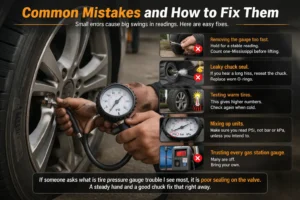
Common Mistakes and How to Fix Them
Small errors cause big swings in readings. Here are easy fixes.
- Removing the gauge too fast. Hold for a stable reading. Count one-Mississippi before lifting.
- Leaky chuck seal. If you hear a long hiss, reseat the chuck. Replace worn O-rings.
- Testing warm tires. This gives higher numbers. Check again when cold.
- Mixing up units. Make sure you read PSI, not bar or kPa, unless you intend to.
- Trusting every gas station gauge. Many are off. Bring your own.
If someone asks what is tire pressure gauge trouble I see most, it is poor sealing on the valve. A steady hand and a good chuck fix that right away.
Buying Guide: Features That Matter
Pick a gauge that fits your routine and gear.
- Range. 0–60 PSI for most cars. 0–100 or more for trucks, RVs, and some bikes.
- Chuck style. Straight is compact. A 45-degree or swivel chuck is easier on tight wheels.
- Bleed valve. Lets you fine-tune pressure with one hand.
- Hose length. A short hose gives control. A longer hose helps on dual wheels.
- Display. Large digits or a clear dial. Backlight helps at night.
- Build. Metal body, rubber guard, and solid fittings last longer.
- Standards and service. Look for a unit you can recalibrate or service if needed.
If you still wonder what is tire pressure gauge best value, aim mid-price. Ultra-cheap tools are a gamble. A well-built gauge pays for itself in saved tires and fuel.
Real-World Tips from the Road
I once ruined a new set of tires on a long trip. My old stick gauge read 32 PSI. A shop-grade digital gauge later showed 26 PSI. The tires ran hot, and the shoulders wore fast. That mistake cost me hundreds.
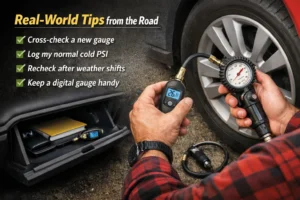
Since then, I do this:
- Cross-check a new gauge with a trusted one.
- Log my normal cold PSI for each season.
- Recheck after big swings in weather.
- Keep a compact digital gauge in the glove box and a dial inflator in the garage.
If a neighbor asks me what is tire pressure gauge they should buy, I hand them mine and show them how to use it. One five-minute lesson sticks for life.
Frequently Asked Questions of what is tire pressure gauge
What is a tire pressure gauge used for?
It measures the air pressure in a tire so you can set the correct PSI. This protects safety, fuel economy, and tire life.
How often should I check my tire pressure?
Check at least once a month and before long trips. Also check after sharp temperature drops.
Which is better: digital or analog?
Both can be accurate. Digital is easier to read, while a good dial gauge is durable and needs no batteries.
Can I trust gas station gauges?
Not always. Many are worn or uncalibrated, so bring your own handheld gauge for accuracy.
What PSI should my tires be?
Use the value on the driver’s door sticker or in the manual. Do not use the sidewall max as your target.
Does cold weather change readings?
Yes. Pressure drops as temperature falls. Expect about 1 PSI drop for every 10°F decrease.
Can I use one gauge for cars and bikes?
Yes, if it fits the valve and has the right range. For Presta valves on bikes, use an adapter.
Conclusion
A tire pressure gauge is a simple tool that prevents big problems. With the right gauge and a quick monthly check, you boost safety, save fuel, and extend tire life. Use the door sticker PSI, test when cold, and aim for consistent, accurate readings.
Make your next drive safer today. Grab a reliable gauge, set your tires to spec, and feel the difference on the road. Want more practical gear guides like this? Subscribe or drop your questions in the comments—I’m here to help.